
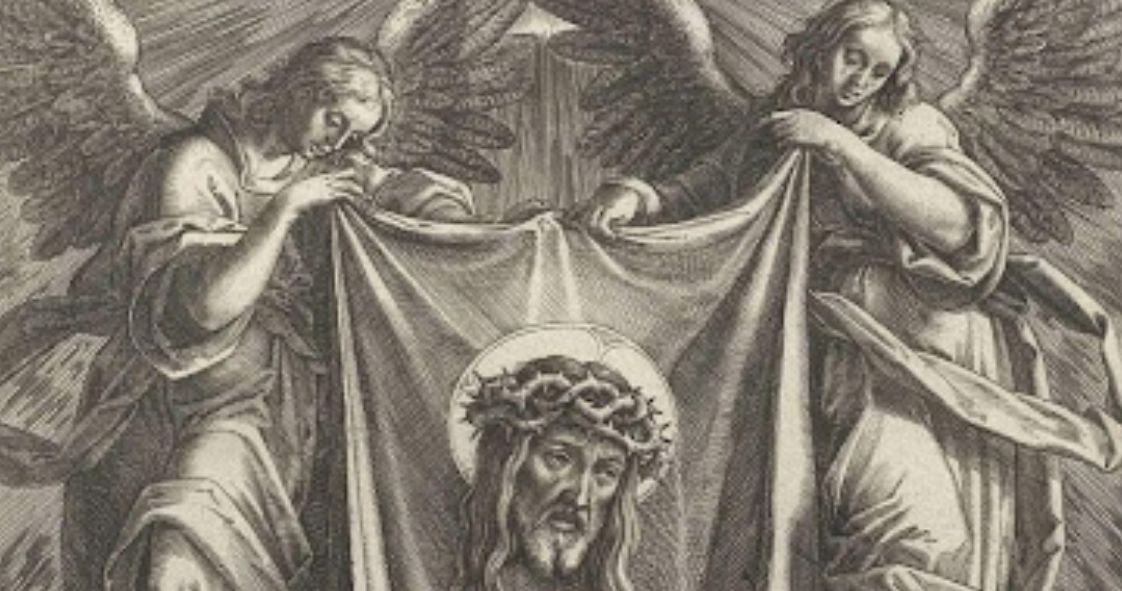
14 & 15 February 2026, 6th SUNDAY IN ORDINARY TIME
A Lenten preparation with the Holy Face
The language that Sirach (from whom we hear too little) appears to be a gentle nudge to keep the commandments – “If you choose to, you can keep them”. To the untrained ear, it sounds more like a suggestion than an injunction; faithfulness to God’s law is optional, the superficial reading suggests: do it if you want to, avoid it if you like. It rightly emphasises that God, the great Law-giver, has endowed us with free will; He has given us His laws, also, to orient our lives towards the good. But it is much more than a suggestion; it’s an invitation to experience the blessing of God. God doesn’t coerce communion, but offers it to us as a free gift.
It echoes that great sermon of Moses in Deuteronomy, right at the edge of the Promised Land in Moab, just before Moses is about to die: “I set before you today blessing and curse, life and death” – in today’s readings, “water and fire”. Any thought that these commands were just a suggestion is slowly fading away. If you choose to keep God’s commandments, you will survive; “Blessed are those who walk in the law of the Lord,” as the Psalmist recalls. But without them? You invite fire, a curse, death.
These commands of God are given to us to choose water, blessing and life; they are invitations to think of the generosity of the Eternal Lawgiver, Who has made us in His image, and for Himself. And because the One Who gives the command is great, and to be trusted, we should keep His commandments.
This is readily understood, then, in Our Lord’s teaching in today’s Gospel, where both the laws and the Lawgiver takes to Himself a human, and holy, face. The laws have not vanished: “Do not think that I have come to abolish the law or the prophets. I have come not to abolish but to fulfil.” They remain important, but in Jesus they become a place of encounter with the very person and nature of God Himself. He isn’t multiplying the commandments, or making them more difficult – “You have heard that it was said…” is not a simple extension of the laws of God. Rather, Our Lord, Who has taken on our human nature, in all things but sin, is revealing the heart of the laws, teaching us their true meaning. He is revealing in them the very Face of God Himself.
It’s not that the commandments have become softer, or less significant; not keeping them doesn’t have a lesser consequence. But now – in Jesus – the commandments of God have taken on a human nature, as it were; in Him, the Lawgiver Himself has come to demonstrate them to us; not only this, He will show us the ultimate consequence of our unfaithfulness – that God Himself would have to die. God’s face, the face of Jesus, shows the effects of our laxity towards the laws of God: a face that is spat on, that endures insult, whose beard is torn, and is covered in sweat and blood. This is the consequence of fire, of curse, of death. But isn’t this also the face of love, which endures all of this for me?
Our hearts have to change. We can’t see these commands as prescriptions to be ticked-off, or as rules to follow. Rather, we can see in the commandments of God:
- Opportunities to grow in love of Him, Who has loved us first;
- Ways to make reparation for our unfaithfulness to the Lord, Who has always been faithful to us.
This renewed view of God’s laws isn’t a philosophical revolution, a simple change in our worldview, as St Paul proposes; rather, it demands us supernatural change of heart in which we deliberately grow in love with God – and if we love Him, we will keep His commandments. What previously we may have done out of fear, now we promise to do for love.
It’s a fitting meditation to make just as we’re about to start Lent – how are we relating to the commands and God, and how – in this season of penance – could we actively choose water, blessing and life? Again, if we shift from the commandments, and from the demands of penance, to the One Who gives the law, our focus shifts.
- Jesus doesn’t demand of us simply to keep the commandments; He demands our focus on His Holy Face, and He demands our love.
- With human features, God’s love is revealed to us.
- It is a love that asks us to do more than keep the commandments – though we could be more faithful.
- Lent helps us to keep God’s commandments more acutely – through prayer, fasting and almsgiving – we are made more faithful to the Lord, Who loves us. It would be good to make a thorough examination of conscience and an integral sacramental confession.
But how could we come to see the Holy Face more deliberately in Lent, too?
On Shrove Tuesday, there is a tradition of offering Holy Mass in honour of the Holy Face of Jesus. It’s part of a larger devotion, which is conscious of the humiliation that Jesus endured in His Passion for love of us, who are not faithful to God’s laws. It is a devotion that tries to make the heart grow more and more in love with God, and to make up for sin the world today. I wonder if we could embrace three practices from this devotion for Holy Lent – and longer! – as we ask God to make our hearts love His laws more and more.
- Honour the Holy Name of Jesus
We recall that there is no other name by which we can be saved; the name itself recalls that God’s love wills to save us, even while we’re still sinners. It is a name at which every knee in on heaven and earth bows; the priest does this, especially during the Sacred Liturgy – if we wear the biretta, we doff it in honour of that Name. We must speak the name of Jesus with reverence and love, never using God’s name in vain – not only because it’s a commandment, but because we love God, Who has loved us first, and want His name to be hallowed, made holy. It could mean promising for Lent that all of our speech be transformed by the name of the Saviour, which rolls from our tongue. No swearing, no cursing, no blasphemy, no evil talk; we will prefer only to speak of holy things, and in a way that edifies and ennobles. We could try to avoid gossip; we could be more committed to the truth. Our tongues, which seek to honour the name of Jesus, will be transformed by the presence of His Name, which we speak tenderly.
Here, we grow in that understanding that keeping God’s commandments is not simply a duty, but a response to a loving invitation to see the face of God, and live.
- Never profane the Lord’s Day
The third commandment urges that we keep the Sabbath holy – for Christians, this is the first day of the week, the Lord’s Day, of His resurrection. “You have heard it said” that Church law requires that we hear Holy Mass, and that we avoid all unnecessary work. This is true, of course. But could we exceed this in offering to God more than the minimum, in honour of His Holy Face, and in reparation for all those profanations of the Sunday? What about, for Lent, avoiding unnecessary housework on Sundays, too – no mowing the lawn or doing the washing; that’s work for Saturday now. We could avoid unnecessary shopping, especially for non-essentials. And what will we do this this newfound time on the Lord’s Day – we could use it for prayer and recreation; we could spend it with our families, recalling that Our Lady and St Joseph looked tenderly on the Holy Face of the infant Jesus, and found themselves looking into the very Face of God. We could try to gaze more intensely at this Holy Face on Sundays in Lent, too.
- Spend time with Jesus, neglected in the Holy Eucharist
Another way we could spend our Sundays – and Saturday nights – is with Jesus, Whose Holy Face is revealed in the Blessed Sacrament. Carving out time to be with the Lord in Eucharistic adoration and Benediction will allow our hearts to grow in love of God, the lawgiver. You don’t have to go Adoration; there’s no precept or law that prescribes us. But we’re growing in love with the Lawgiver, and we want to spend more time with Him, looking at Him, and have Him looking at us.
In a sense, we’re keeping watch with Him, too, in reparation for the Apostles who sleep while He is in anguish; His Holy Face sweats blood, while His friends snore. We’re bringing to Jesus a kiss of love in reparation for the traitor’s kiss. We’re being like the attentive St Veronica, who wipes the Holy Face with her veil. And, like her, being attentive to Jesus in the Blessed Sacrament, we can be sure that His Holy Face will imprint itself on our hearts more and more. If we’re willing to spend that extra time with Jesus, present in the tabernacle, in the monstrance, for love of us, our hearts, our faces, will resemble his Own more.
And so, as we stand on the threshold of Lent, these words echo with a particular poignancy: “If you choose…” It is not the voice of threat, but of invitation. It moves beyond the mere consequences of disobedience, but is an appeal of covenantal love. Israel once chose the calf, yet the Lord showed them His Face again in mercy. Now the choice is offered anew — not abstractly, but personally, revealed in the Holy Face of Jesus. In Christ, the command is no longer merely spoken; it is embodied and exemplified. It is a Face that is not distance, but here: veiled, silent, truly present in the Holy Eucharist. The same Face once bruised in Jerusalem now rests upon the altar. How could we resist the demands of the Face that loves us?
It is Your Face, Lord, that I seek; hide not Your Face from me. Amen.