
21 & 22 February 2026, 1st SUNDAY OF LENT
On this First Sunday of Lent, the Church places before us a garden and a wilderness. More than two physical places, they are two spiritual conditions. The garden is the place of harmony, abundance, intimacy, right relationship with God. The wilderness is the place of desolation, testing, of stripping away, of decision. It is the place where we discover what truly governs our lives. In the garden of Eden, humanity turned away from God and became disoriented. In the wilderness, Christ turns toward God completely, and in doing so, He reorients humanity once again toward its true centre.
The Genesis account in the First Reading speaks to us in rich and vivid imagery. God forms the man from the dust of the earth and breathes into him the breath of life. This tells us something essential about who we are. We are creatures, yes. Formed from dust, we are material, fragile, finite. We were reminded of this on Wednesday when ashes were placed on our foreheads with the words “Remember, man, that you are dust and unto dust you shall return”. But we are also more than dust. We live because God breathes His own life into us. So, our existence is not self-sustaining or self-sufficient. It is sustained, necessarily and moment by moment, by God Himself. From the beginning, human life is properly oriented toward God as its source and its end.
And God places the man and the woman in a garden which represents order, abundance, communion. Everything they need is provided. They do not grasp or seize; they receive. They live in trust. Their lives are structured around relationship with God. This is what it means to be rightly oriented: to live with God at the centre, and everything else in reference to Him.
But then the serpent enters, and the temptation unfolds in a subtle and familiar way. The serpent does not begin by denying God outright. Rather, he shifts the focus. He draws attention away from God and onto the fruit. He invites the woman to see the fruit as something desirable in itself: good for food, pleasing to the eye, desirable for gaining wisdom.
None of these things are evil in themselves. Food is good. Beauty is good. Wisdom is good. The tragedy is not that these things exist, but that they become detached from God (the Creator, sustainer, and provider) in the human imagination. The gaze of the human heart shifts. Instead of seeing the fruit in relation to God, the woman begins to see it in relation to herself, her hunger, her desire, her satisfaction, her fulfilment.
This is the moment of disorientation. The centre shifts. God is no longer the reference point. The self becomes the reference point.
And this is the essence of what we call the “fall”. It is not merely the breaking of a rule. It is the breaking of relationship. It is the turning of the human heart away from God. It is the attempt to ground one’s life in something created, something temporary, rather than in the Creator Himself.
The consequences are immediate. Shame, fear, alienation rush in. When we turn away from God, we lose the one in whom our lives have their coherence and meaning.
This is the condition of humanity into which Christ enters when He becomes incarnate. This is the human situation he comes to heal.
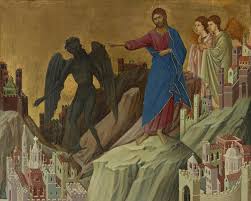
The Gospel today brings us not into a garden, but into a wilderness. Jesus has just been baptised. He has just heard the voice of the Father: “This is my beloved Son.” He stands in perfect relationship with the Father. And then He is led by the Spirit into the wilderness. The wilderness is a place of deprivation. It is a place where distractions are removed. There is no abundance, no comfort, no illusion of self-sufficiency. It is a liminal space—a space between what was and what will be. It is a place where truth becomes clear. And it is there, in that place of hunger and vulnerability, that Jesus is tempted.
Every year (A, B, and C of the lectionary) we begin Lent on the first Sunday with an account of the Temptation of Jesus in the desert. This year we have the account from Matthew’s Gospel.
The first temptation is simple and direct: “If you are the Son of God, command these stones to become bread.” Jesus is hungry. Bread would satisfy a real, legitimate need. But the temptation is not simply about bread. It is about orientation. It is about whether Jesus will define His life by His physical hunger, or by His relationship with the Father.
In Matthew’s account, each temptation is responded to by Jesus with Scripture from the Book of Deuteronomy.
To this first, Jesus responds: “Man shall not live by bread alone, but by every word that comes from the mouth of God.” He does not deny the reality of hunger. He refuses to treat bread as ultimate. He recognises that bread is temporary. Material satisfaction is temporary. Life itself comes from God. And so, He reorients everything toward the Father.
The second temptation is more subtle. The devil takes Him to the pinnacle of the temple and tells Him to throw Himself down, to force God to intervene. This is the temptation to control God, to make God serve one’s own purposes, to seek certainty and security on one’s own terms. This is a kind of pagan religion where we make god(s) in our own image and then try to manipulate them by pleasing or appeasing them.
Jesus responds: “You shall not put the Lord your God to the test.” He refuses to make Himself the centre. He remains oriented toward trust in the Father.
The third temptation is the most expansive. The devil shows Him all the kingdoms of the world and their glory and offers them to Him. (As if they were his to offer…) Here is power. Influence. Recognition. Everything the world considers significant. But it is all temporary. Kingdoms rise and fall. Glory fades. Power passes from one hand to another.
Jesus responds: “You shall worship the Lord your God, and Him only shall you serve.” In this moment, Jesus reveals the truth that was forgotten in Eden: only God is absolute. Everything else is secondary. Everything else is passing. Where Adam grasped at what appeared desirable, Jesus entrusts Himself to the Father. Where Adam turned away and became disoriented, Jesus turns toward, and remains perfectly oriented toward God.
In doing so, He doesn’t simply correct Adam’s mistake. He restores humanity’s capacity to live in right relationship with God. This is why St Paul tells us that through the obedience of Christ, the many will be made righteous. Christ becomes the new centre. The new point of orientation. The one in whom humanity is restored. A Sacramental focus for us, that we can know, perceive, relate easily to, and so, remain oriented even in a disorienting world.
This is what Lent is for us. Lent is a wilderness season. It is not meant to be comfortable. It is meant to be clarifying. Through prayer, fasting, and almsgiving, we allow some of the excess, the noise, and the distractions of our lives to fall away. We voluntarily enter a kind of wilderness, so that we can see more clearly again.
Fasting reminds us that we do not live by bread alone. Prayer reminds us that God is the source of our life. Almsgiving reminds us that our lives are not centred on ourselves, but are oriented toward God and toward our neighbour. These practices are not punishments. They are acts of reorientation. They help us recover the truth about what is ultimate and what is temporary.
Because the reality is that we are constantly being pulled toward disorientation. We are constantly tempted to treat temporary things such as success, comfort, recognition, security, as though they were ultimate. We are constantly tempted to build our lives around things that cannot last. Lent invites us to step into the wilderness with Christ, so that we can learn again how to see. So that we can learn again how to live. So that we can become people whose lives are truly centred on God.
The wilderness is not the final destination; not for Jesus and not for us. It is a place of preparation. A place of purification. A place of renewal. In the garden, humanity turned away from God and lost its centre. In the wilderness, Christ turns toward God and restores that centre. During Lent, the wilderness focuses our minds on what is truly lasting, eternal life, and on what makes this possible, the Resurrection that we will celebrate in six weeks’ time.
Now, in this season of Lent, He invites us to walk with Him. To allow our hearts to be reoriented. To recognise the passing nature of so many things that claim our attention. And to fix our gaze once again on God, who alone is permanent, who alone is faithful, who alone is life.
For in the end, Lent is not about what we give up. It is about toward whom we turn. It is about returning to the One who breathed His life into us in the beginning, and who alone can lead us, through the wilderness, back into the fullness of life. Amen.