
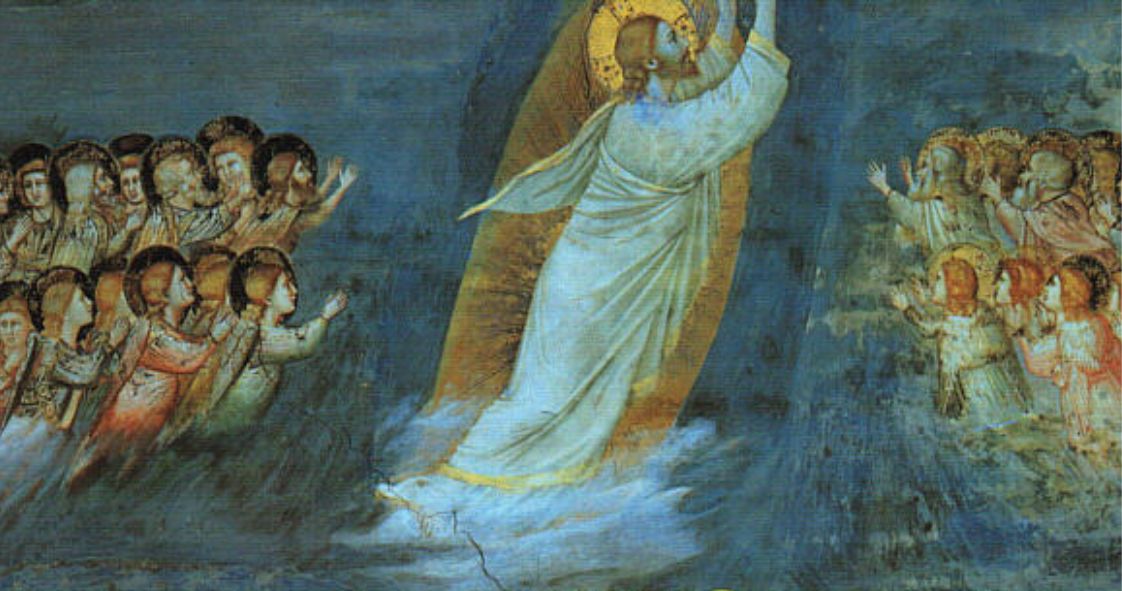
This Sunday in South Africa we observe the Solemnity of the Ascension of Our Lord. The Compendium of the Catechism of the Catholic Church teaches: “After forty days during which Jesus showed himself to the apostles with ordinary human features which veiled his glory as the Risen One, Christ ascended into heaven and was seated at the right hand of the Father. He is the Lord who now in his humanity reigns in the everlasting glory of the Son of God and constantly intercedes for us before the Father. He sends us his Spirit and he gives us the hope of one day reaching the place he has prepared for us.” (Compendium of the Catechism of the Catholic Church, No. 132).
In his homily on Ascension Day in 1979, Ascension Day that year, visiting the Venerable English College in Rome, St John Paul II preached on mystery we celebrate this Sunday:
“In the providence of God – in the eternal design of the Father – the hour had come for Christ to go away. He would leave his Apostles behind, with his Mother Mary, but only after he had given them his instructions. The Apostles now had a mission to perform according to the instructions that Jesus left, and these instructions were in turn the faithful expression of the Father’s will.
The instructions indicated, above all, that the Apostles were to wait for the Holy Spirit, who was the gift of the Father. From the beginning, it had to be crystal-clear that the source of the Apostles’ strength is the Holy Spirit. It is the Holy Spirit who guides the Church in the way of truth; the Gospel is to spread through the power of God, and not by means of human wisdom or strength.
The Apostles, moreover, were instructed to teach – to proclaim the Good News to the whole world. And they were to baptize in the name of the Father, and of the Son, and of the Holy Spirit. Like Jesus, they were to speak explicitly about the Kingdom of God and about salvation. The Apostles were to give witness to Christ to the ends of the earth. The early Church clearly understood these instructions and the missionary era began. And everybody knew that this missionary era could never end until the same Jesus, who went up to heaven, would come back again.
The words of Jesus became a treasure for the Church to guard and to proclaim, to meditate on and to rive. And at the same time, the Holy Spirit implanted in the Church an apostolic charism, in order to keep this revelation intact. Through his words Jesus was to live on in his Church: I am with you always.”
Click here to read the full homily.
(An historical note: it was only two days after delivering the above homily that St John Paul paid his historic visit to the Roman Oratory to celebrate the feast of St Philip Neri, 26th May, as we ourselves are preparing to do at the end of this month. In the context of the recent declaration of St John Henry Newman as Doctor of the Church, we reproduce words of the Pope spoken on that occasion: “Faithful of Rome! How many things we can and must learn from our great Saint [St Philip]! He speaks to each of us: ‘Cor ad cor loquitur’ as the great Cardinal Newman, converted from Anglicanism, used to say. When, after long and meticulous historical researches and after interior suffering, he was obliged by the evidence of the proofs to embrace Catholicism and enter the Church of Rome, becoming acquainted with the life and spirituality of St Philip, he became so enamoured of him, because of his depth, balance and discretion, that he wished to become an Oratorian priest. He founded the first Oratory in England, always followed his example, as his admirable addresses bear witness, and called him ‘my personal Father and Patron Saint’. He concluded his most famous work: ‘Apologia pro vita sua’ with the name of St Philip. For us, too, St Philip continues to be our ‘Father’. Let us invoke him! Let us listen to him!”)