
Be the Presence of Jesus till the end of the age
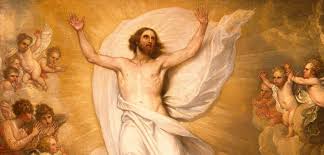
The older Roman Rite includes a striking visual cue to what happens on Ascension Thursday. After the Gospel, which ends with a description of Our Lord’s disappearance from the sight of the Apostles, a server descends from the Sanctuary to the Easter Candle and snuffs it out before the sermon begins. Christ, the Light of the World, Who took human flesh in Our Lady’s womb, and Who conquered the darkness of sin and death, has disappeared as He said He would. The disciples gaze up in wonder and confusion: He just told them that He would not abandon them until the close of the age and then, He is taken from their sight. In the midst of their bewilderment, an angel calls them from their sky-gazing to the mission that the Lord entrusted to them. Go to Jerusalem and pray.
For what, or Whom, would they pray? For the One Whom Jesus called “the Counsellor”, the Holy Spirit, Who would descend to them on Pentecost Sunday. Why would Our Lord do this? St Thomas Aquinas aids us, as ever!
Recognising, first, the human desolation of the Apostles, Whose Lord, Master and intimate friend had departed from them, St Thomas recalls that the gift of the Holy Spirit is to bring comfort to the bereaved. They didn’t understand well, the Evangelists recall; at this point, even after their lengthy witness of the Resurrection, some doubt; sin and ignorance cloud their minds, while a cloud hides the Lord from them. They’re still afraid of the Jewish leaders; they’re still inclined to hide lest they succumb to the same death that temporarily claimed the Lord, but which would likely have enduring effects for them. And so the Holy Spirit is sent to console them in their loss.
But how would He do this? It would be more than a simple, cold-comfort “There, there”. Rather, it would be a supernatural consolation that comes from yielding their hearts to the Lord as a home for Him. The Spirit is poured into their hearts to bring about in the Apostles, and all believers, the very life of the Trinity; they would be more perfectly united to the New Law, which is written not on tablets of stone, but in man’s heart by the “finger of God’s right hand”, as the ancient hymn recalls. God, living in their hearts, as they should have expected from the teaching of God Who lived among them in Jesus, would make them less inclined to worldly lures, and more desirous of heavenly realities. There is already something of an ascension in their way of living; their minds would be drawn up to where their Head and Founder had already gone before.
This deeper connection to heavenly realities is a direct fruit of the Holy Spirit dwelling in their hearts. As the Divine Guest of their souls, the Holy Spirit reveals the truth to them, as Jesus had promised. Christ had taught them; there was no defect in His teaching. But the Apostles were slow to learn. Now, with God living within them, in a new and radical way, their memories were illuminated: they recalled the details of Our Lord’s life and teaching in a vibrant way. They were able to understand more perfectly the depth of this holy doctrine; their way of life would be governed, now, by divine wisdom rather than a simple human philosophy. What they knew now far exceeded a mere intellectual growth; they were beginning to think with the very mind of Christ Himself – this is a fruit of the Spirit, dwelling in their hearts, making them more devoted to the truth. They were able to fall more in love with Truth now that the Spirit of Truth possessed their hearts.
Not only were they more disposed to the truth, but they became willing to be disposed themselves. They not only lived for it, but were willing to die for it: and all, with the exception of the faithful Saint John, did – brutally, even. By the indwelling of the Holy Spirit, they were made more than adorers of truth, even more than conquerors in Christ Jesus. They were bold witnesses, who feared nothing of this world, but only focussed on those heavenly realities, which bring with fervour a tremendous sweetness.
There’s no doubt that they were courageous; courage often makes a man more aggressive, even violent. But what characterises the fortitude of the Apostles’ proclamation is a heavenly sweetness, which persuades by the force of what it is rather than by the way it is presented. They did not need eloquence or special tools of rhetoric; they transcended the brutal tactics of conversation which characterised the pagan peoples. Rather, they taught the truth with Divine charity, preferring to win hearts for God than to win debates about holy things. In this, they weren’t weak; God’s strength was made manifest in their obedience to their mission – to teach, to preach, to baptise.
All the while, in a silent, but certain way, their hearts were being confirmed more and more according to the pattern of Our Lord’s Own heart. They diminished as He increased in them. Others would see them slowly fade away, with the image of the Lord appearing in them more and more. “To live is Christ,” St Paul would say: “It is no longer I who live, but Christ Who lives in me.” This Christian identity was evident in the Apostles, who began to bear the image of their Lord.
And so His promise finds fulfilment. He hasn’t abandoned us; He has not withdrawn Himself from us. He has sent the Holy Spirit to make His Heart present in each of us. He is not separated from the world when He has commissioned us to be His presence in it.
He remains present in His Mystical Body, the Church; He is objectively present in the Most Blessed Sacrament of the altar; He wills to be present, too, in each believer, called to be His witnesses to the end of the age. And this invitation is too precious, and too urgent, to ignore.
Isn’t this precisely what the Lord has achieved in the lives of the saints? We think especially now about how this is true in the life of Our Holy Father, Saint Philip, whose novena we begin today, and whose feast we celebrate soon. To St Philip is given that radical miracle of the Holy Spirit being poured into his heart; he experiences no desolation when that Divine Guest takes up residence, painlessly, in his body. He demonstrates in his daily work the life of the Trinity: loving the poor, being devout to Our Lady, exhibiting an attraction to the things of heaven – especially to the Holy Eucharist and the Saving Sacrifice of the Mass. With a martyr’s heart, he willed to be spent for love of the truth; Rome received the constant attention and affection of this saint, who drew his spiritual children into a deep communion with God by the exercise of a wonderous charity, evident in his confessional (and in some of his more spectacular penances!). Like Newman, when we see St Philip, so caught up in the Divine life, “[w]e see the image of his Lord;/ The Saint dissolves amid the blaze/ Which circles round the Living Word”.
Would that be so for us, too?
Let us ask Our Lady, that privileged home of the Holy Spirit, to pray for His coming into our hearts so that, consoled by His presence, we would be caught up in the presence of the Lord even while on earth, awaiting our own coming to heaven. Amen.