
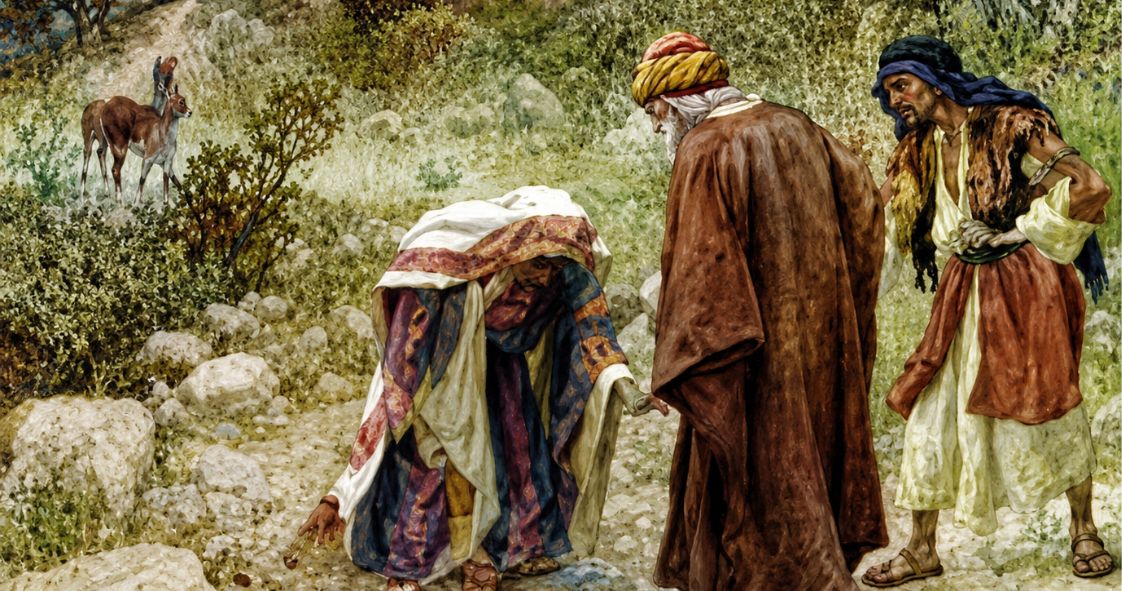
The readings today ask us a simple question: who has room in our lives? Who shapes your decisions? Who receives your attention and your energy? Who or what has the ability to change the way you live? Let us begin with the first reading from the Book of Kings. We a very simple story which introduces us to four fascinating people: Elisha the prophet, a wealthy woman from Shunem, and her husband, and Gehazi, Elisha’s servant. This story reveals something important about God and our response to him.
Whenever Elisha passed through Shunem, this prominent woman insisted that he stop and eat. The relationship develops. First she offers a meal. Then she persuades her husband to build a small room on the roof with a bed, a table, a chair and a lamp. A very ordinary description. There is nothing luxurious here. Just the essentials for someone who is constantly on the move. Why is this story included in Scripture? We don’t hear about every rest stop where the prophets stay.
What this story illustrates is what it looks like to recognise the presence of God. The woman recognises something before anyone else says it aloud. She tells her husband, “I know this is a holy man of God.” She recognises holiness. Which means she has cultivated the kind of spiritual sensitivity that allows her to perceive God’s presence in another person. Perhaps that is one of the first questions today’s readings ask us: Would we recognise holiness if it appeared at our front door?
If we are honest, that is not always our instinct. Sometimes goodness in another person makes us uncomfortable. It holds up a mirror to our own lives. Their patience exposes our impatience. Their generosity highlights our selfishness. Their prayerfulness challenges our distractions. Holiness has a way of quietly asking us, “Could you love more? Could you forgive more? Could you trust God more?” Rather than allowing ourselves to be challenged, it is often easier to criticise, dismiss or even resent the person who reminds us of what we could become. Pride whispers that if someone appears holier than we are, then somehow we are diminished.
Into this thought we can look at the woman’s husband. He is an interesting figure because he says almost nothing. Yet his silence is not indifference; it is cooperation. He could easily have questioned his wife’s judgement or resisted the inconvenience and expense of building a room for Elisha. Instead, he allows himself to be led by her spiritual insight. In every Christian marriage there are seasons when one spouse sees more clearly than the other. Wisdom lies not in insisting that I must always be the spiritually perceptive one, but in having the humility to receive God’s guidance through the faith of the person beside me.
So the husband is not threatened by the holiness she recognises. He does not compete with it or dismiss it. He simply makes room for it. Sometimes one of the greatest acts of faith is not to be the first to recognise God’s work, but to have the humility to trust someone who has. The saints teach us that the holiness of another is never a threat; it is an invitation. God allows us to encounter holy people not to discourage us, but to awaken in us a deeper desire for the life he wants to give us.
And then there is Elisha himself. Unlike many powerful people, Elisha does not exploit the generosity shown to him, or feel entitled to the kindness shown by others. He responds to generosity with generosity. He asks his servant Gehazi, “What can be done for her?” He even offers political influence. “Can I speak to the king or the commander of the army on your behalf?” Her reply is striking: “I live among my own people.” In other words, “I don’t need status. I don’t need favours. I am content.” Her generosity to Elisha was because he was God’s prophet, not a utilitarian quid pro quo relationship.
How refreshing that is in a world where relationships are often transactional. We are constantly tempted to ask, “What can this person do for me? What advantage will I gain?” The woman of Shunem expects nothing in return. But God sees what even she has not voiced. We then meet Gehazi, Elisha’s servant, who quietly observes that she has no son, and her husband is old. This unspoken sorrow becomes the place where God acts. Elisha promises that within a year she will hold a son in her arms. It reminds us that God sees the deepest longings we ourselves may scarcely dare to express. Prayer is not about handing God a list of things to do. It is about entering into a relationship in which we learn to recognise his presence and become open to the gifts he knows we truly need.
Jesus seems to echo this story in today’s Gospel. “Whoever welcomes a prophet because he is a prophet will receive a prophet’s reward.” It is almost as though Jesus has the woman of Shunem in mind. She welcomed the prophet, and she received far more than she expected. She received life itself.
Jesus immediately pushes the principle much further. He says that whoever loves father or mother more than him is not worthy of him. Hard words. Jesus is not telling us to love our families less. The Fourth Commandment remains. Rather, he is asking us to love everyone in the right order. Think of the planets orbiting the sun. They remain in harmony because everything revolves around the same centre. If each planet tried to become the centre itself, chaos would follow. Our relationships work the same way. When Christ occupies the centre, we actually become better sons and daughters, better spouses, better parents, better friends. But when anything, even something good like family or career or reputation, takes Christ’s place, eventually everything else becomes disordered. Jesus asks to be the centre of our lives. The sun around which our life orbits.
Perhaps that brings us back to the room on the roof in Shunem. What makes it possible for her to respond in this way? Her recollected heart. Her contentment with what she has. Her expectation of encountering holiness in others. We can foster a similar disposition, by ensuring we build room for Christ in our lives. In our homes, our conversations, our decisions, our schedules and our hearts.
A recollected heart is not something we are born with; it is something we practise. Five quiet minutes before the Blessed Sacrament. Beginning the day with Scripture before looking at our phones. Ending the day by thanking God for three blessings we have received. Small practices like these slowly teach us to recognise God, until eventually we begin to notice his presence where we once saw only ordinary life.
When we make room for Christ, we often imagine that we are giving something away. But we see today that the woman gave a room and received a child. The disciples are asked to lose their lives, and they discover true life. Those baptised into Christ die with him only so that they may live with him. God is never outdone in generosity.
There is one final detail in this story that the lectionary does not tell us. Elisha’s servant, Gehazi, who first noticed the woman’s hidden sorrow, later became a tragic figure. In the next chapter he secretly pursues Naaman and lies in order to obtain silver and fine clothing that Elisha had refused. The woman of Shunem welcomed God’s prophet without asking for anything in return; Gehazi tried to use God’s gifts for his own advantage. She was content with what she had, and God freely gave her the deepest desire of her heart. Gehazi was not content, grasped for more, and ultimately lost everything. The contrast is striking. One life is shaped by gratitude and generosity; the other by acquisitiveness and self-interest. It is a reminder that contentment is not simply a pleasant virtue, but the fertile soil in which God’s greatest blessings take root.
The woman of Shunem did not become generous by accident. She had first become the kind of person who could recognise God. Her heart had been recollected rather than distracted; grateful rather than grasping; expectant rather than cynical. Those same dispositions can be cultivated in us. We make room for Christ through daily prayer, gratitude for what we have received, attentiveness to his presence in ordinary life, and small acts of charity. Then, when Christ passes by, as he so often does, we shall recognise him. Amen.