
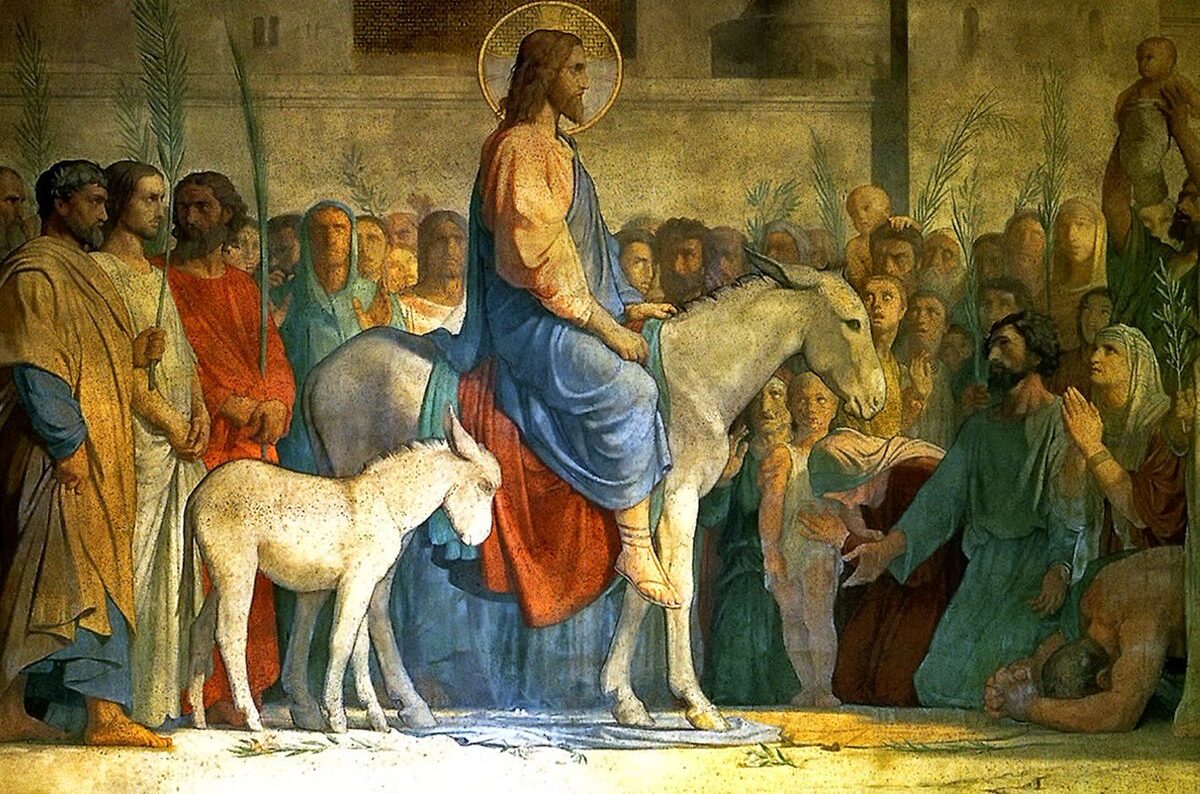
Today’s first reading evokes Holy Week and specifically Palm Sunday, containing the prophecy applied to Our Lord’s entry into Jerusalem by the Gospel authors: “Rejoice … daughter of Jerusalem! Behold, your king comes to you … triumphant and victorious … humble and riding on a donkey.” This striking image of a Messiah king contrasts with expectations of the Messiah stressed in other passages of the Old Testament which refer more to the glory or majesty of Messianic expectation: this Messiah-King entering Jerusalem does so, rather, in humility and lowliness. He may be victorious, but he does not bear the outward signs of military victory or conquest in the usual sense.
We understand instinctively as Christians that here the lowliness of Christ is designated. Jesus certainly did not enter Jerusalem as a warrior king. Zechariah prophesies not only Our Lord’s entrance into Jerusalem but in a veiled way describes the mystery of the incarnation itself, of Jesus who, as Paul says “though he was in the form of God, did not count equality with God a thing to be grasped, but emptied himself, taking the form of a servant, being born in the likeness of men. And being found in human form he humbled himself and became obedient”. (Phil. 2:6-8)
Let us say that today’s readings (starting with this first reading from Zechariah) invite us to reflect on the mystery of redemption specifically on Jesus as Son of God. The Son is the one who receives a mission; the Son is the one who is sent. All things (as Jesus says in today’s Gospel) have been delivered to him (the Son) by his Father, in other words, he has been entrusted with the redemption of the world. Now in his incarnate life, Jesus continually shows himself as dependent on the Father and Our Lord attributes everything to him: this is implied in the prayer of thanksgiving in the Gospel: I thank you, Father, Lord of heaven and earth. For as St James teaches, from the Father of lights comes down every good and perfect gift (cf. James 1:17). And it is to the Father on the cross that Our Lord offers himself as obedient Son, “Father, into your hands, I commend my spirit.” (Luke 23:46)
Now if Our Lord states in the Gospel that God’s mysteries have not been revealed to the wise and understanding (to the proud of heart or mind) but that he has revealed them to infants, or to the little ones, as the Alleluia verse has it or (to apply another expression in the Gospel) to the gentle and the lowly in heart, Our Lord is (delicately but unmistakably) alluding to his own condition as incarnate Son. Jesus does nothing of his own accord but speaks as the Father has taught him (cf. John 5:19; 8:28). He speaks the truth he has heard from God (cf. John 8:40). We even read in the book of Revelation (1:1) that God has given Jesus a revelation of what soon must take place. Our Lord gives us the model of the one who receives God’s truth in humility and love, even growing in wisdom (Luke 2:52) with a heart and mind always open to receive – that attitude characteristic of the child, the infant, the lowly one. But it is also in this state of humility – that is, the form of the servant, Our Lord’s incarnate state on earth – that Jesus is able to communicate these mysteries to those ready to receive them, that is to those who – after his example – show a humble and child-like receptivity. “The word which you hear is not mine but the Father’s who sent me.” (John 14:24) “All I have heard from my Father I have made known to you.” (John 15:15). Whoever hearing this word humbles himself like a little child, who receives with meekness this divine word (cf. James 1:21), takes as his model Jesus himself. We see then the fuller sense of the words: “I thank you, Father, Lord of heaven and earth, that you have hidden these things from the wise and understanding and revealed them to infants; yes, Father, for such was your gracious will.”
For us who live after the public ministry of Jesus as members of his Church this truth is made known to us by the work of the Holy Spirit, the Spirit of Christ, the Spirit of Truth, who will declare the things that are to come (cf. John 16:13), who will bear witness to Jesus (cf. John 15:26), who will “take what is mine and declare it to you” (John 16:15). To listen to the Spirit speaking to us through the Church therefore invites us to cultivate that same child-like disposition of which Our Lord speaks, for it is the same divine word of Jesus to which the Spirit today bears witness. Moved by the Spirit of Christ, as St Paul says in the second reading, we will “belong to Christ”; so we will be guided into all the truth. Amen.