
‘I want everyone to go to heaven’
This year, we celebrate an extraordinary year of St Francis of Assisi, commemorating the 800th anniversary of his death. Two significant legends come to us from his life, which we could use today as a structure for meditation around the readings for this Sunday. The first is perhaps the better known.
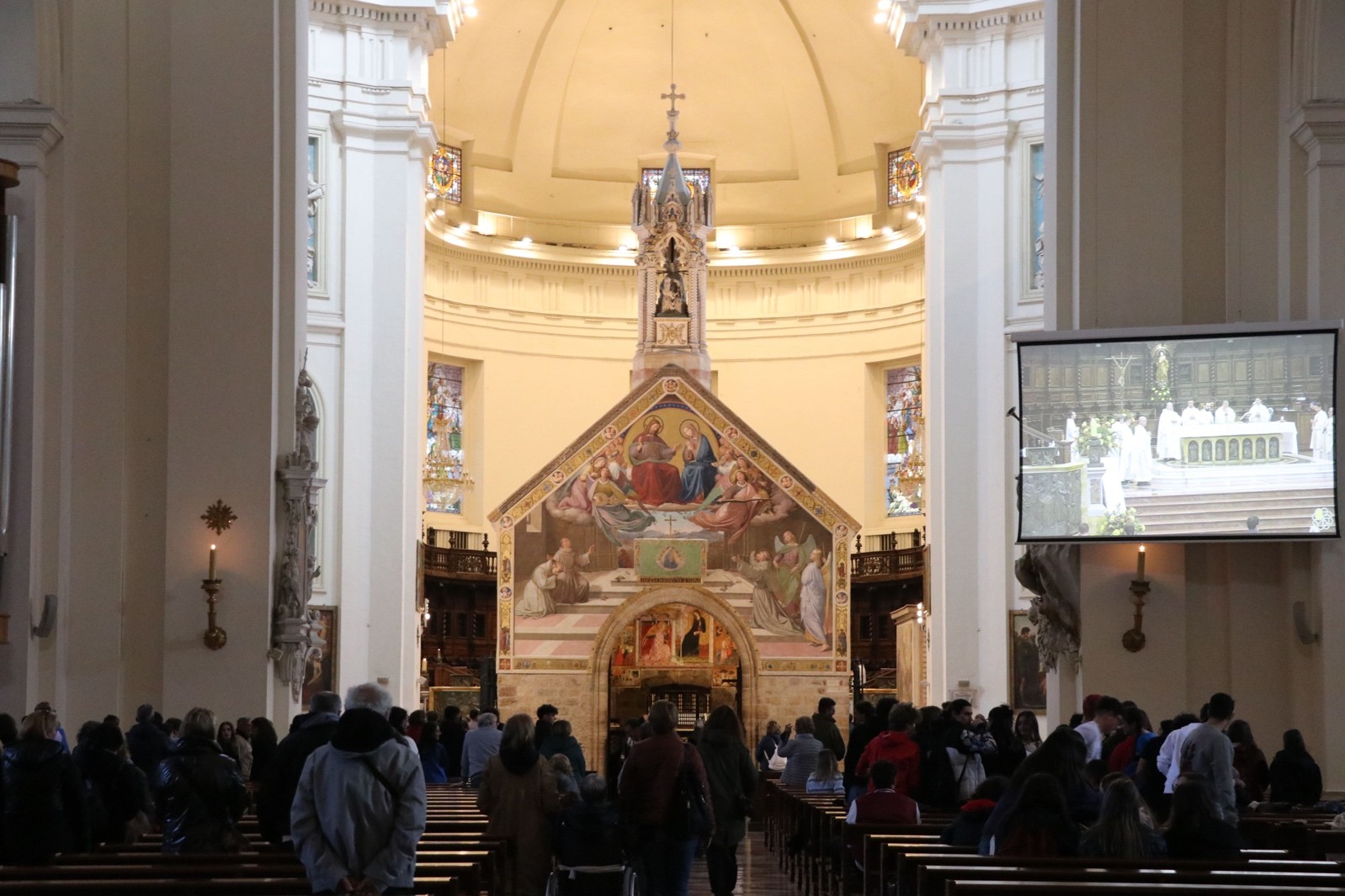
As a young man, in the earliest days of his conversion, Francis entered the ruined church of San Damiano, outside Assisi. Kneeling before the crucifix, he heard the Lord address him: “Francis, rebuild my Church, which, as you see, is falling into ruin.” Francis, with that marvellous simplicity which belongs to the saints, initially understood the command quite literally. He looked around him and saw a chapel whose walls were crumbling, whose roof was neglected, and whose fabric required repair. He therefore began gathering stones. He begged for materials. He rebuilt the little church with his own hands. Only gradually did Francis come to understand that Our Lord had spoken of something much greater than stone and mortar. Christ’s Church was indeed in need of rebuilding, but her deepest ruins were not damaged walls. They were wounded souls, forgotten commandments, neglected sacraments, the scandal of worldliness, and the absence of that evangelical simplicity by which men recognise that God is enough. Yet Francis’s first interpretation was not entirely mistaken. He began with the small, concrete obedience placed before him. He could not yet see how God intended to use him in the renewal of the whole Church, but he could replace one stone, restore one sanctuary and rekindle one sanctuary lamp. The universal work of renewal began in fidelity to the little thing immediately at hand. Among the churches which Francis restored was a tiny chapel in the plain beneath Assisi, dedicated to Our Lady of the Angels. It was called the Portiuncula, the “little portion”. It was there that the young Franciscan fraternity began to take shape; it was there that Francis returned again and again for prayer; and it was there, at the end of his life, that he wished to die.
A second Franciscan tradition is associated with that little chapel. In the year 1216, ten years or so after the command received at San Damiano and, incidentally, in the very year in which the Dominican Order received its formal confirmation, Francis was praying in the Portiuncula when the chapel was filled with heavenly light. He saw Our Lord, with His Blessed Mother beside Him, surrounded by the angels. Our Lord invited Francis to ask for whatever favour he desired. One can imagine all the things which Francis might have requested. He might have asked for the prosperity of the Order which had grown around him. He might have asked for protection from opposition, for the conversion of rulers, or for some extraordinary sign which would confirm his mission. Instead, Francis asked something for sinners: “I want everyone to go to heaven.”
He begged that those who visited that little shrine, truly repentant, having confessed their sins and received Holy Communion, might obtain a full remission of the temporal punishment due to sin; that they might, in the confident language of Christian devotion, be made ready for paradise. Our Generous Lord granted the request, but instructed Francis to seek its confirmation from the Pope. Francis therefore went to Pope Honorius III and asked that the favour granted at the Portiuncula should be confirmed by the authority of the Church.
The Pardon of Assisi, or Portiuncula Indulgence, has been associated ever since with the feast of Our Lady of the Angels on 2 August. The privilege has long since been extended beyond that little chapel in Assisi. Today, the faithful may gain the indulgence in Franciscan churches and shrines and, under the customary provision, in parish churches as well.
This means that the grace St Francis desired is not merely an interesting story belonging to medieval Italy. It is offered here, to us, today. You came to Mass in order to honour that important precept – and you get more than you bargained for!
A person who visits a parish church with the intention of gaining this indulgence, who makes a good confession and receives Holy Communion within the customary period, who prays for the intentions of the Holy Father, and who is detached from every sin, may receive this plenary indulgence for himself or apply it to a soul in Purgatory. The prayers for the Holy Father are ordinarily very simple: an Our Father and a Hail Mary are sufficient; the Creed is also traditionally associated with the visit to the church. The condition which may appear most difficult is that one be detached from sin, even from venial sin. This does not mean that we must already have conquered every weakness, nor that we must be certain never to fall again. It means, rather, that we do not deliberately reserve some sin for ourselves; that we are not saying to God, “I give You everything except this.” We cannot intend to return to some sinful practice. We cannot deliberately maintain an impure relationship. We cannot knowingly continue in dishonesty. We cannot actively nourish a grudge, while insisting that this resentment is the one possession which even God may not ask us to surrender. We may be weak, and often tempted. We could even fear that we will fall again. But weakness is not the same as attachment. The question is whether we sincerely wish to be free; whether we are willing for the grace of God to reach every part of our lives. In that sense, the promise of heaven is opened before us with astonishing generosity.
It is as though God fulfils, in this relatively simple act of the Church, the invitation spoken by the prophet Isaiah in the first reading:
“All you who are thirsty, come to the water;
you who have no money, come, buy and eat.”
We can come without money, without a claim on God, Who owes us nothing and yet gives us everything from. We come without any reason to demand His generosity. We can’t purchase grace. We cannot even earn the merits of Christ, arriving at the market of mercy with sufficient wealth to buy eternal life. We come poor, and God gives.
Faced with this generosity, Isaiah asks: “Why spend your money on what is not bread, your wages on what fails to satisfy?” The question is painfully familiar. There are so many things upon which we spend ourselves and which leave us unsatisfied. We spend our attention upon distractions which cannot nourish the soul. We spend our emotional strength upon resentments which make us smaller. We spend our time upon trivialities, our affection upon things which cannot love us in return, and our energy upon ambitions which seem so urgent until, suddenly, they are not. There are minor satisfactions which are not evil in themselves, but which easily become substitutes for God. There are sins which promise comfort, excitement or revenge, but which leave us more restless than before. There is our inertia, that spiritual heaviness by which we know what God is offering and still cannot quite bring ourselves to rise and receive it.
Yet the psalm tells us:
“You open wide your hand
and grant the desires of all who live.”
God opens His hand. He is not reluctant offering grace grudgingly, as though fearful that too many sinners might take advantage of His mercy. He offers us the great gift of heaven, urging us – with the words of St Paul in mind – to let nothing “separate us from the love of Christ”. The only thing can can separate us from God is our clinging to sin; our sin is a refusal of love. Not because God ceases to love the sinner, but because the sinner closes himself against the love which is being offered. And so the tragedy is not that God’s hand is closed. The tragedy is that our hearts often are.
But today, the Lord wants to set us free. The indulgence is not a reward for those who have already made themselves perfect. It is a work of mercy directed towards those who know that sin has consequences and that, even after guilt has been forgiven, much disorder remains within us and around us. Confession forgives the guilt of sin and restores us to friendship with God. Yet sin leaves wounds. It strengthens bad habits, weakens our resistance, damages the communion of the Church and produces temporal consequences which divine justice and mercy must heal. The indulgence applies to these consequences the inexhaustible merits of Christ, together with the prayers and merits of His Blessed Mother and all the saints. The Church, as steward of this treasury, does not invent grace; she administers what Christ has already won for love of us.
The Portiuncula Indulgence is only one among many such opportunities. There are numerous works to which the Church attaches an indulgence: the devout reading of Sacred Scripture, adoration of the Blessed Sacrament, the Rosary prayed in a church, family or religious community, the Way of the Cross, spiritual exercises, and the renewal of our baptismal promises on the anniversary of our baptism. It would be worthwhile to consult a reliable devotional book or the Church’s own Enchiridion of Indulgences, and to discover how frequently the Church opens to us the treasury of divine mercy. These acts are not “magical formulas” or incantations, manipulating God. They are works which dispose us to receive what God already desires to give. Daily mental prayer opens the heart to Him. The reading of Scripture makes the mind more receptive to His voice. The renewal of our baptismal promises recalls us to the dignity we have already received. The indulgenced work is a meeting place between the generosity of God and the willing cooperation of the Christian.
And we can trust this invisible communion of grace because we have known the Lord to be faithful in the visible administration of His gifts. The Gospel gives us the multiplication of the loaves and fishes. Our Lord sees the crowd, and His compassion makes a material difference. The disciples see only scarcity; the Lord sees an opportunity for generous love. And what He does visibly with bread, He does invisibly with grace. In the Holy Eucharist, the generosity of Christ is greater still. He does not merely multiply bread for a crowd. He gives Himself as the Bread of Life. His compassion makes an invisible difference in those who receive Him well. He nourishes the soul, heals weakness, strengthens charity and prepares us for the life of heaven. The same Christ who fed the multitude offers us the fruits of His Passion. The same compassion which moved Him to take the loaves into His hands moves Him to take our poor acts of repentance and join them to His infinite merits. His generosity can always be trusted.
Perhaps this is the deepest connection between the two visions of St Francis. At San Damiano, Christ told St Francis to rebuild His Church; at the Portiuncula, St Francis showed that he had come to understand the command. The Church is rebuilt whenever a sinner is reconciled to God. She is rebuilt whenever resentment is surrendered, impurity abandoned, a confession is made, the Holy Eucharist received with devotion, and a soul restored to the freedom of grace.
With the help of St Francis, we can receive today the fruit of his saintly request. We can also make his intention our own. It is not enough that I should desire heaven only for myself. The Christian heart must widen. We should desire heaven for our families, for those entrusted to us, for the indifferent, for those who have wounded us, and even for those who seem determined to avoid God. We should do whatever lies within our power to help them arrive there. What precisely that requires of us would be another homily, and this one has been long enough already! But we can begin today.
We can begin by asking God for the generous graces offered through this little feast of Our Lady of the Angels. We can make a good confession, receive Holy Communion devoutly, pray for the intentions of the Holy Father, and surrender every deliberate attachment to sin. Then, with St Francis, we may dare to ask something greater than a private favour: Lord, I want everyone to go to heaven, and, please dear Lord, start with me. Amen.