
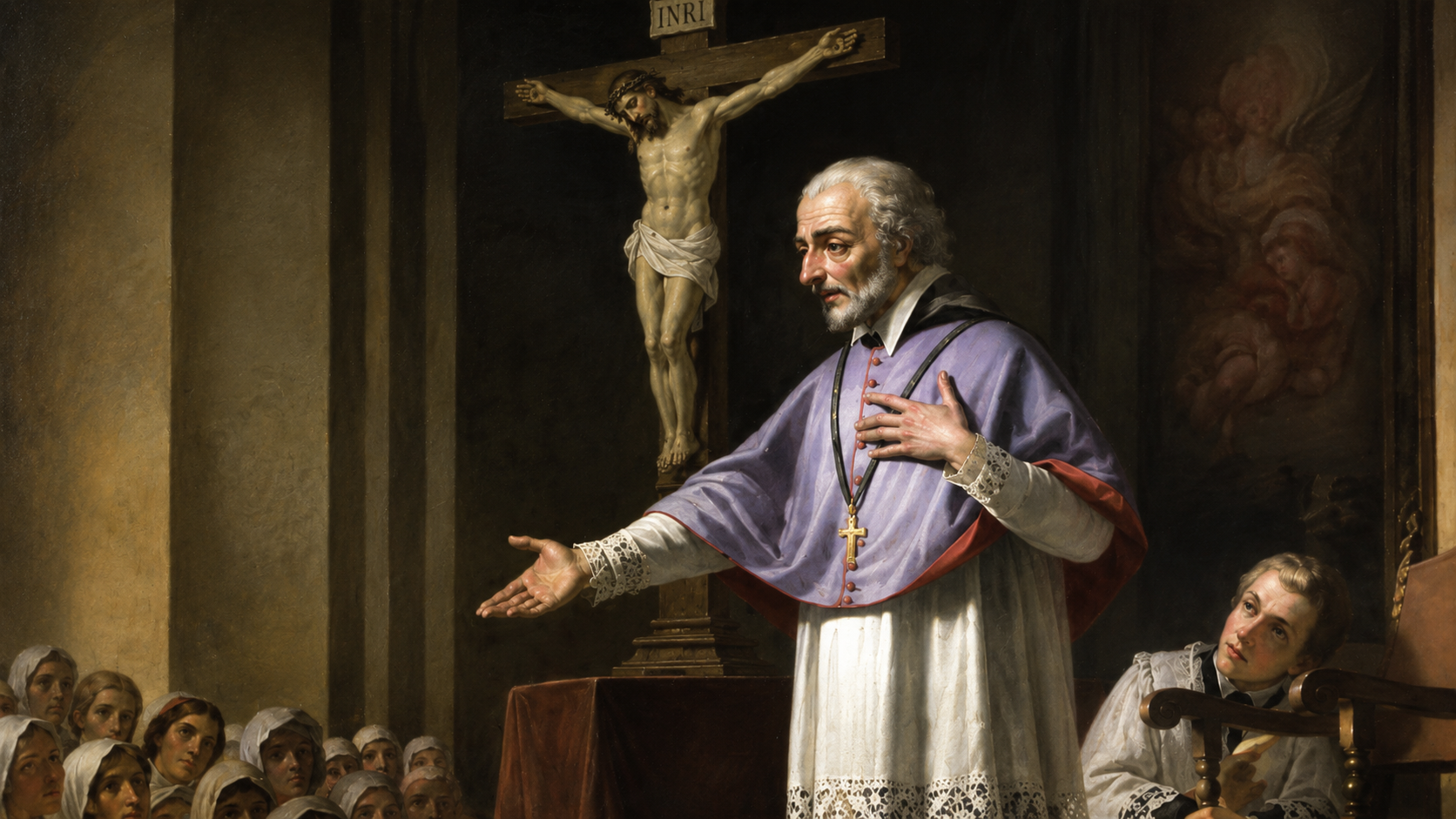
Blessed Juvenal and the Renewal of the Mind
On Friday, we celebrated the feast day of St Augustine, special to us as the patron of our cathedral and a son of our African soil. The conversion story of this esteemed doctor of the Church allures us too – he’s the bad boy turned good in the annals of the saints. After a life of sin – theft, lust, deception, disregard – he encounters the Lord as an answer to the prayers of his holy mother, St Monica, through the preaching of St Ambrose of Milan. He realises that nothing that he was doing in which he sought pleasure could ever really bring him fulfilment; there was a disconnection between his heart and the One Who made it. “You have made us for yourself, O Lord, and our hearts are restless until they rest in You”.
We could be tempted, though, to look at this great work of conversion and fail to see ourselves in it. “I’m not that awful,” we could think – and risk that jolt to reality, which St Augustine’s life provides. “I’m no scoundrel, needing such a dramatic tug from evil living to the life of grace”. In truth, we all need to pulled back to the Lord, Who calls us to renounce ourselves, take up our crosses and follow him. Perhaps today’s hidden saint might offer us a more gentle approach to conversion, where we may see ourselves more readily.
Juvenal Ancina was, on all accounts, a reasonably pious man; he lived, as one author proposed, “a blameless life”; he was a medical doctor of renown, as well as a musician, poet and a litterateur; by the reckoning of the world, he was far from being a scoundrel like Augustine! There was already a lot to recommend him to the Lord, and to us; there didn’t seem to be a need for an Augustinian conversion. And yet, being a sinner as we all are, Juvenal needed to experience the call of the Lord, too. Walking in the streets of Savigliano, in 1572, he stopped at a church where a Requiem Mass was being offered. He heard the words of that Sequence Dies irae – “Day of wrath, the dreadful day” – which recalls that the soul, after this life, will account to God, the Merciful Judge. God required more than simply “a blameless life” from Juvenal. Thinking of the last things, he thought more about his own life. He didn’t find the catalogue of sins, that St Augustine may have done. Rather, he asked a question that reflects Jesus’ stirring words in today’s Gospel: What does it profit a man – even a learned man, a good man, the so-called blameless man – if he gains the whole world (of letters, of skills, of civilisation and culture) and forfeits his soul?
He realised that his own life bore accomplishment; he had become much in the estimation of his peers. But had he really given himself entirely to God? He asks himself what more he could be towards God; what more did the Lord want him to do? And eventually, this question, burning in his heart, brings him to Rome, and in Rome, to St Philip; Doctor Juvenal of Piemonte becomes Father Juvenal of the Oratory. He moves from nursing bodies to nursing souls, rendering to the Lord the full measure of all of his life, his learning and his skill, letting the Lord dispose of him as God desires. Unlike St Augustine’s restless heart, Blessed Juvenal had – in the words of the Psalmist – a still thirsty heart, desiring to love God more perfectly.
This contains the substance of a conversion, too. It is, as St Paul puts it in the Second Reading, a “renewal of the mind”. “Do not conform yourselves to this age,” he tells us, “but be transformed by the renewal of your mind, that you may discern what is the will of God, what is good and pleasing and perfect.” That is precisely what began to happen in Juvenal. He handn’t suddenly discovered that everything he had done before was wicked. His mind was renewed so that he could look again at all that was already good in his life and ask a different question of it: what does God want me to do with this?
And perhaps this is where Blessed Juvenal comes rather closer to most of us than St Augustine does. Most of us are probably not waiting for some dramatic conversion from a spectacular life of vice. We have jobs and duties; we love people; we try to say our prayers; we come to Mass; we try, with varying success, to be decent people. There may well be much in our lives which is good and pleasing to God. But the Christian life cannot finally be satisfied with the verdict, “I’m likely a reasonably good person”. Certainly, Blessed Juvenal was already that. The question of conversion remains: Lord, what more do You want of me?
- Of what in my life have I not yet allowed You to dispose?
- Where am I content merely to be blameless, when You are asking me to be holy?
- Where have I decided that I have given enough?
This is where Our Lord’s words in the Gospel become more demanding than they might at first appear: “Whoever wishes to come after me must deny himself, take up his cross, and follow me.” We can imagine that self-denial belongs particularly to the great sinner: Augustine must deny his passions, his pride, his old way of life. But Blessed Juvenal shows us another kind of self-denial. Sometimes what must be surrendered is not something wicked at all. It is my own selfish claim on my life: my plans for it, my accomplishments, my gifts, my learning, my time; even my idea of how much of myself God may reasonably ask. A saintly life must
- recognise that all that I am, and have, is a gift from God, and
- that the Lord is asking me to orient all of these things to Him, for His Church and for His glory
None of Blessed Juvenal’s talents and skills disappeared when he rendered them to the Lord in the Oratory. Rather, by placing them all at God’s service, grace took hold of them, and used them for good. What was previously his own could now, properly, become God’s own, to be used for winning souls, beginning with Juvenal’s own.
Can we make a move towards that type of conversion too? We’re not just saying to God, “I’ll give up my sinfulness to you”. Rather, we’re offering our whole selves, and all that we are, all that we’ve learned, to the Lord, Who will be pleased with that offering. We will give up trying to oppose God, like St Peter tried to do; we will to be good collaborators with the Lord, Who desires that we yield all that we are, and have, to Him.
What can this mean practically?
- If I’ve a skill that could benefit the Christian community, offer it to the Lord by volunteering your time and talent – bake for the CWL, help Fr Jonathan do maintenance things, offer your voice to sing in the choir. The Lord does not need me to acquire somebody else’s talents before I can serve Him; He asks me what I am doing with the ones He has already given me.
- If I’m learned in some area of life, I could direct something of my studies towards a sacred orientation. If I’m a botanical expert, I could learn about the flowers and plants which occur in Sacred Scripture, or those which Christian tradition has associated with Our Lady and the saints. If I’ve an interest in ancient civilisations, I could discover the world in which the early Christians lived, or how the Fathers took what was true and beautiful in Greece and Rome and placed it at the service of Christ. A musician can discover the Church’s treasury of sacred music; an artist, her great tradition of sacred art. We needn’t become less interested in the things we love: like Juvenal, we can ask how those interests might lead us towards God.
- If I have some material blessing, ask whether a little more of it could be put at God’s disposal. Perhaps I have a spare room which could offer hospitality; a car which could bring someone to Mass; a little money which could quietly help someone in need; a pleasant garden, or a lovely kitchen, which could sometimes welcome others. Christian generosity begins when I stop asking only, “May I have this?” and begin asking, “Lord, what might You do with this?”
- If I have influence or experience, use it to build someone else up. The retired teacher can help a struggling child; the accountant can advise someone looking for work; the older Catholic can befriend the young person who is trying to find his feet in the Church; the parent whose children are grown can encourage the exhausted young parents. Much of what God has taught us over a lifetime was perhaps never intended to end with us.
- And perhaps most simply: give the Lord some time which presently belongs entirely to me. Ten minutes more in prayer; coming to Holy Mass once during the week; reading a little of the Scriptures; visiting someone who is lonely. We need not wait for a dramatic vocation before giving more of ourselves to God.
In all these things, I am asking God to make more of what I have, as His gift, and to give it to Him more freely. I’m not asking Him for more; I’m asking Him to use me more, discerning His will for me – and we can be sure that if we do this, we have the prayerful help of Blessed Juvenal Ancina, that soul-thirsty son of St Philip!