
Just around the corner from here, most mornings, there are men standing waiting for work. Gardeners, painters, handymen, men who will take whatever manual labour is available that day. Cars slow down, perhaps one or two are chosen, and the others remain behind. We know the sight so well that perhaps we hardly notice it anymore.
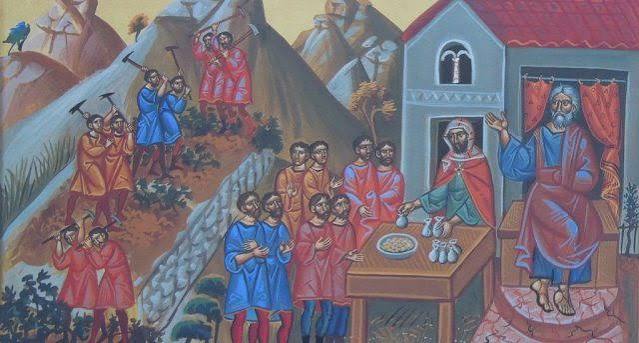
That makes today’s Gospel unusually easy for us to picture. Jesus describes men standing in the marketplace waiting to be hired. The landowner comes out early, then again at nine, at midday, at three, and finally at five o’clock, almost at the end of the working day.
He asks the men still standing there: “Why have you been standing here idle all day?” And they answer: “Because no one has hired us.” Notice what they do not say. They do not say that they did not want to work. They are still there at five o’clock, still hoping to be chosen. And the landowner says simply: “You go into my vineyard too.”
But to understand why Jesus tells this story, we need to look just before today’s Gospel. The rich young man has come to Jesus, asking what he must do to inherit eternal life. Jesus tells him eventually to sell what he owns, give to the poor, and follow him. The young man goes away sad.
Peter has watched all of this. And Peter says: “Look, we have left everything and followed you. What then will we have?” I do not think we should be too hard on Peter. It is a perfectly human question, and in Peter’s case it is also true. He has left his boat, his nets, his livelihood, much of the security of the life he knew. Following Christ has cost him something.
Jesus does not tell Peter that his sacrifice means nothing. Quite the opposite. He promises him astonishingly generously. But then he adds: “Many who are first will be last, and the last first.” And immediately he tells the story of the labourers in the vineyard.
It is as though Jesus is saying: Peter, I know what you have given up. I know what following me costs. But be careful that discipleship does not become a ledger in which you keep your account with God. Be careful that you do not begin measuring your sacrifice against somebody else’s.
That is what happens to the first labourers. They are not bad men. They have worked from early morning and borne the heat of the day. They have done exactly what was asked of them, and the landowner pays them exactly what was agreed. Their unhappiness begins only when they see what somebody else receives. Comparisons become the enemy of, and destroy, gratitude.
And their complaint is revealing: “You have made them equal to us.” Not simply, “You have been unfair to us.” But: “You have made them equal to us.” That is the real offence. They have begun not only to measure the wage, but to measure the worth of the other workers. We worked all day. They came at the end. Surely that must mean something about us, and something about them.
Now think again of the men standing around the corner from us looking for work. By midday one man has been chosen and another is still standing there. It is very easy for us to construct a story about why. Perhaps he is lazy. Perhaps he is unreliable. Perhaps he has wasted opportunities. But very often we know none of that. We see only that he is still standing there. The Gospel gives the late workers one explanation: “No one has hired us.”
That is a useful warning about the way we judge one another. We can usually see the hour at which somebody entered the vineyard. We cannot see the whole day they have spent standing in the marketplace. We can see the choices someone has made; we often cannot see the fear, the history, the wounds, the opportunities they never had, the times they tried and failed. That does not mean that actions do not matter, or that right and wrong cease to exist. But it does mean that we should be very cautious about turning a judgment about an action into a judgment about the worth of a person. Just because someone’s sins, challenges, weaknesses, are more visible or manifest, does not mean they are necessarily more grave, or deserving of less empathy, compassion, or assistance.
And perhaps that is why “You have made them equal to us” is such an uncomfortable sentence. We are often quite willing for God to be merciful, provided his mercy does not disturb the little ranking system we have constructed. We are comfortable with forgiveness in the abstract. It becomes harder when God is generous to someone we have already decided deserves less.
The apostles themselves struggle with this. Soon afterwards James and John seek the places at Jesus’ right and left, and the other ten become indignant. Perhaps they are offended by the ambition. But perhaps there is also a little of: Why should they have those places? What about us? Jesus is patiently trying to free good men from the need to establish where they stand in relation to everybody else.
Isaiah gives us the key: “My thoughts are not your thoughts, nor are your ways my ways.” In context, those words are about mercy: the sinner returning to the Lord, who is “rich in forgiving.” God’s thoughts exceed ours particularly in the generosity of his mercy. We count the hours. God sees the person. We remember how late someone came. God sees that they came. We ask what they deserve. God goes out again at five o’clock and says: “You go into my vineyard too.” God cannot be outdone in generosity. We are called to imitate this.
And notice the first word the landowner says to the complaining worker: “Friend.” “My friend, I am not being unjust to you.” There is tenderness even in the correction. It is almost possible to hear Christ speaking to Peter: Peter, I know what you have given up. I know what you have carried. I will not be ungenerous to you. But do not let my goodness to someone else become an offence to you.
St Paul gives us a glimpse of what freedom from all this looks like. In prison, uncertain whether he will live or die, he says that to depart and be with Christ would be better for him, but that remaining may be more necessary “for your sake.” In Christian maturity, he is no longer primarily asking what life owes him. He is asking what fruit his life can still bear for someone else.
And perhaps the loveliest final word comes much later, after the Resurrection. Peter has denied Christ, been forgiven, and been restored. Jesus tells him something of the sacrifice that still lies ahead. Peter immediately looks across at the beloved disciple and asks: “Lord, what about him?” Still looking sideways. Jesus says: “What is that to you? You follow me.” Discipleship is our mission.
Perhaps that is the word for us today. We do not know everybody else’s story. We do not know how long they have been standing in the marketplace, or why they arrived in the vineyard when they did. We do not need to keep everybody else’s account with God. Our task is simpler, and harder: to trust and imitate his generosity (especially in mercy), to rejoice and have gratitude for his mercy and the blessings we receive, and to follow him so that our discipleship may bear fruit in the world. Amen.