
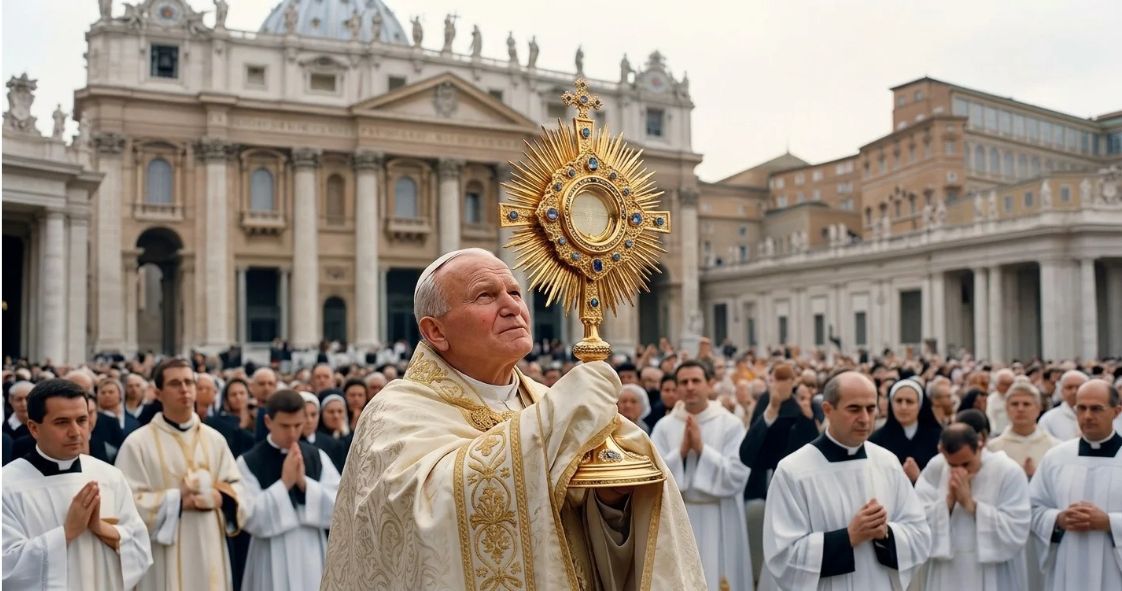
Pope from 1978, John Paul II’s memory, example and teaching is deeply inscribed upon the Catholic Church of recent times and his influence continues to be felt up to the present day. Born in Poland, near Cracow in 1920, Karol Wojtyla was ordained to the priesthood in 1946 (just one year before our church of St Bernadette opened here in Port Elizabeth). Later made both Archbishop and Cardinal, he was elected as the Successor of St Peter in 1978, the first non-Italian to hold office since the 16th century.
Frequently remembered for his many international travels, the Pope made 104 foreign visits in the course of his long papacy (in addition to those within Italy), including his 1995 visit to South Africa. No less important were the Pope’s many teaching documents, including his first encyclical Redemptor Hominis (1979), Centesimus Annus on social issues (1991) and Veritatis Splendor on the Church’s moral teachings (1993), which retain their perennial relevance. (Notably, the Pope’s Apostolic Exhortation on the Church on our continent, Ecclesia in Africa, was promulgated in Johannesburg in 1995.) Ecumenical relations extending to all Christians included a special emphasis on the Eastern Christian tradition and Orthodox churches, as well as working for full visible unity with those of the Reformed Tradition.
John Paul’s remarkable pastoral zeal, personal devotion and charity to all made many to consider him a saint already in his lifetime, and the patient bearing of his illnesses in his later years gave testimony to a Christian spirit which strengthened believers as much by his actions as by his words. St John Paul, who died in 2005, was declared a saint in 2014; his feast day of 22nd October is the anniversary of the inauguration of his papal ministry in 1978.
In view of our forthcoming Forty Hours Devotion and marking the feast day of the saint, we reproduce St John Paul’s words on Eucharistic Adoption from his encyclical letter Ecclesia de Eucharistia (2003), No. 25.
The worship of the Eucharist outside of the Mass is of inestimable value for the life of the Church. This worship is strictly linked to the celebration of the Eucharistic Sacrifice. The presence of Christ under the sacred species reserved after Mass – a presence which lasts as long as the species of bread and of wine remain – derives from the celebration of the sacrifice and is directed towards communion, both sacramental and spiritual. It is the responsibility of Pastors to encourage, also by their personal witness, the practice of Eucharistic adoration, and exposition of the Blessed Sacrament in particular, as well as prayer of adoration before Christ present under the Eucharistic species. It is pleasant to spend time with him, to lie close to his breast like the Beloved Disciple (cf. John 13:25) and to feel the infinite love present in his heart. If in our time Christians must be distinguished above all by the “art of prayer”, how can we not feel a renewed need to spend time in spiritual converse, in silent adoration, in heartfelt love before Christ present in the Most Holy Sacrament? How often, dear brother and sisters, have I experienced this, and drawn from it strength, consolation and support!