
Can God work through the lives of people who do not know him, do not love him, and do not actively seek his will?
We might instinctively think of God’s work as something accomplished through those who believe in him, who pray, and who seek to live according to his will.
But today’s readings offer us a surprising insight. Consider Cyrus, the Persian king, whom we encounter in the first reading. Cyrus did not know the God of Israel. He did not worship him, nor did he consciously seek his will.
Nevertheless, God addresses him in extraordinary language. He calls Cyrus his anointed, and says: “I have called you by your name, though you do not know me.” (cf. Isaiah 45:4)
Here is a pagan ruler who, without knowing it, becomes an instrument of God’s plan to liberate his people from exile.
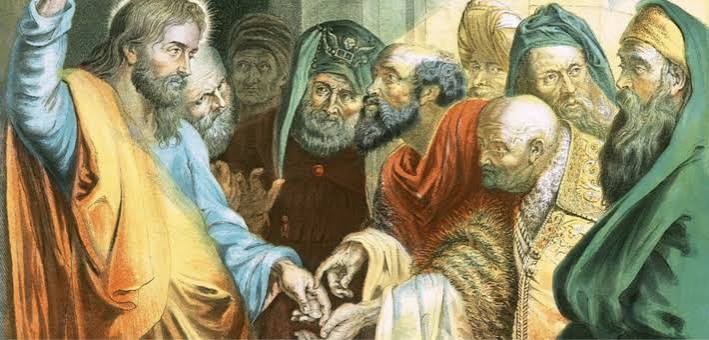
Now consider the Gospel. Centuries have passed. The Persian Empire has disappeared, and Rome has become the dominant power. Caesar has replaced Cyrus.
Although Caesar is not physically present, his authority looms large over the politically charged exchange between Jesus, the Pharisees and the Herodians. Like Cyrus, Caesar does not acknowledge the God of Israel as his Lord.
And yet, when Jesus later stands before Pontius Pilate, the Roman governor, he will say: “You would have no power over me unless it had been given you from above.” (John 19:11). It is under Roman authority that Jesus will be condemned and handed over to be crucified. The Son of God, rejected, humiliated and put to death.
And yet, through his death and Resurrection, God brings about the salvation of the world. What appears to be the greatest injustice becomes the occasion of God’s greatest gift to humanity.
This does not mean that God approves of injustice. Rather, it reveals something extraordinary about his providence: God can bring good even out of evil, without ever making evil good.
Consider the implications of this for our own lives.
We, too, encounter our own Cyruses and Caesars: people who exercise authority over us, whether in public life, at work, or even in our homes. People whose decisions affect our lives, and whose values we may not always share.
We also encounter circumstances we would never have chosen: disappointment, betrayal, illness, uncertainty, suffering and bereavement.
We do not have to pretend that these things are good, or that trusting in God means passively accepting injustice.
Instead, we are invited to recognise that God is at work within us, even in circumstances where life seems beyond our control. Even amid the brokenness of our world, his grace works to transform us and draw us toward holiness.
So, what are we to do? Simply wait for things to work out in the end? Not at all. Our response is anything but passive. St Paul gives us a beautiful indication of what that response might look like.
Writing to the Thessalonians, he gives thanks for their work of faith, labour of love and steadfastness of hope (cf. 1 Thessalonians 1:3).
Notice that their faith is not simply something they profess and leave at the church door. Their love is not merely a feeling. Their hope is not wishful thinking that everything will turn out as they would like.
Faith, hope and love have become visible in the way they live, in the way they respond to the circumstances of their lives.
And perhaps this is where today’s readings lead us, to a second question:
In the circumstances of your life, how might God be inviting you to act in faith, labour in love, and persevere in hope? Not in an imaginary life where everything goes according to plan, but in the life we actually have, with its joys and sorrows, its difficulties and disappointments, its Cyruses and Caesars.
We need not rush to answer. Whenever we celebrate the Eucharist, we are invited to unite ourselves to Christ’s self-offering to the Father. This is always a work of faith, labour of love and steadfastness of hope.
And this Friday evening, 23 October, at 17:30, we begin our parish’s Forty Hours Devotion with Holy Mass. Throughout the weekend, we will have the opportunity to spend time in adoration before the Blessed Sacrament and to receive God’s mercy through the Sacrament of Reconciliation.
Perhaps we might come not simply to ask God to change the circumstances of our lives, but to offer ourselves to him in the midst of them. To place before him the world as we experience it, with all its beauty and brokenness, and to ask for the grace to conform our wills to his. That our faith might become more active, our hope more steadfast, and our love more generous. Amen.
First Reading – Isaiah 45:1, 4–6
Responsorial Psalm 96:1, 3–5, 7–10 “Give the Lord glory and honour.”
Second Reading – 1 Thessalonians 1:1–5
Gospel – Matthew 22:15–21