
We start today a two-part series “Composer of the Week”, on two of the composers whose works will feature in the Musical Oratory in our church on Friday 27th March:
Anton Bruckner was born in Ansfelden village in Austria in 1824 and began organ lessons with his father, the schoolmaster at a young age. After the death of his father in 1837, he became a choirboy at the Augustinian monastery of St Florian’s in Upper Austria. After completing his studies, he worked as a teacher in Windhaag and Kronstorf an der Enns. During this time, he began developing his skills as a composer. In 1845, he returned to St Florian’s as the organist. It is here that he composed a Missa solemnis (WAB 29) which caught the attention of the prominent music theorist Simon Sechter, who agreed to take him on as a composition student.
Bruckner quietly worked as the organist at Linz Cathedral from 1855 to 1868. When he began working in Vienna from 1868, his Catholicism became more noticeable to his contemporaries, such as Johannes Brahms, who wrote that “He is a poor, crazy man who has the priests of St. Florian on his conscience.” His humility, piety and perfectionism led many to simply disregard him as an eccentric obsessive compulsive. Nonetheless, Bruckner continued to compose, producing an output of music rivaling that of his contemporaries, with symphonies, choral music, organ works, as well as other instrumental works. His ninth symphony, his last and incomplete symphony, contains the dedication “dem lieben Gott” (“to the beloved God”). He died in 1896 and was buried beneath the organ at St Florian’s, at his request.
Though the 19th century tends to be thought of as an era of symphonic music, Anton Bruckner’s output of sacred music can be as highly regarded as his symphonic output. At our Musical Oratory on 27 March, we shall hear one of his lesser known motets, his Salvum fac populum tuum (WAB 40). This work is based on the final verses of the Te Deum, the traditional Catholic hymn of thanksgiving. The work is presumed to have been commissioned by Franz Xaver Witt (another Catholic composer) for the Cecilian Society, a choral society with the aim of restoring Gregorian chant and polyphony to the liturgy. Bruckner’s motet alternates the verses between a harmonized form of Gregorian chant (called Falsobordone) and polyphony reminiscent of the late Renaissance. The following recording by the Latvian Radio Choir encapsulates the antiphonal nature of this work superbly: https://www.youtube.com/watch?v=zPP48BZscDE
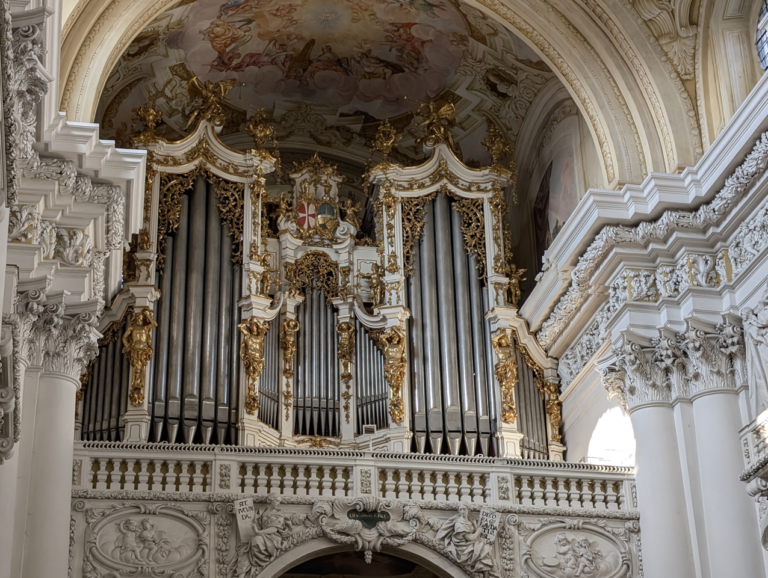
The Bruckner Organ at St Florian’s Monastery in Austria

Bruckner at his piano, with a crucifix on the wall behind him