
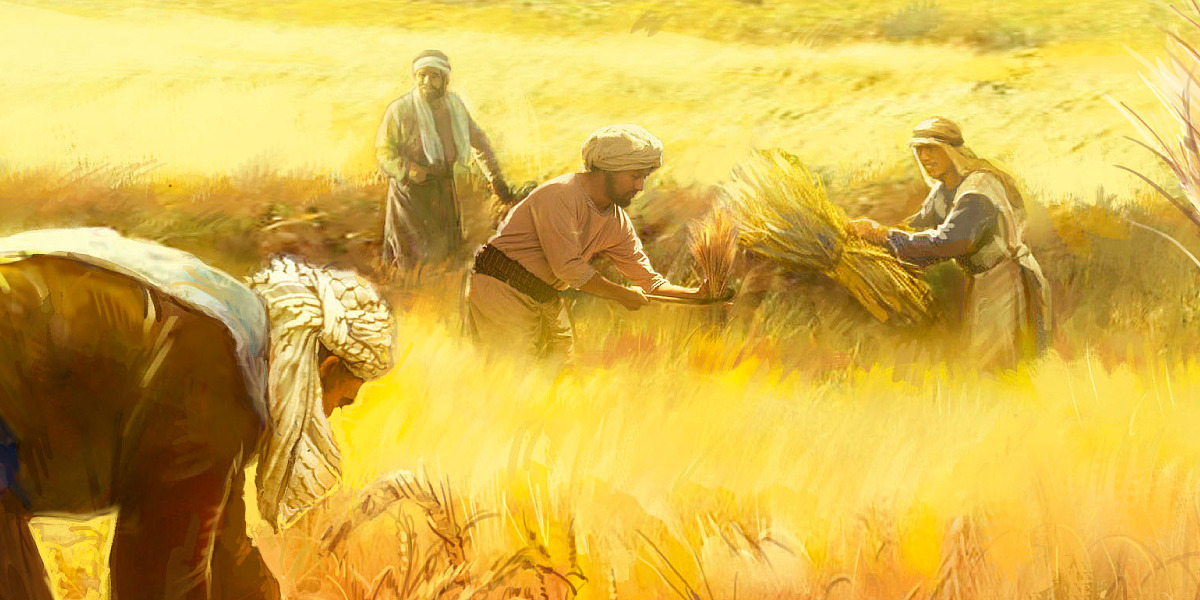
Imagine yourself to be the farmer in today’s Gospel. You rise early. A bag of seed hangs over your shoulder. With each step you reach into the bag and scatter another handful across the field. Every handful is an act of hope. No one sows seed expecting failure. We sow because we believe there will one day be a harvest.
Perhaps we have all been that farmer. Every worthwhile thing we have ever begun has started with hope. A husband and wife stand before the altar on their wedding day. Parents receive their newborn child. We join or return to a parish community. Friendships begin. Someone decides it is time to forgive. Someone else quietly resolves to begin again.
Each is like a handful of seed cast upon the earth.
Now imagine returning to your field. The wheat has begun to grow. There is joy and relief. Then you notice something else. Weeds. Suddenly, the field is no longer as you imagined it would be.
Isn’t that true of almost everything we love? The marriage we cherish also knows misunderstanding. The children we delight in also keep us up at night. The parish we love also brings disappointment.
Even when we sincerely seek to follow Jesus, we meet with resistance, some from within and some from outside. The wheat and the weeds grow together.
Perhaps our response is like that of the servants in the parable.
“Master, didn’t [we] sow good seed? Where have the weeds come from?”
“Help us to pull them up?” It seems the obvious thing to do. It seems the responsible thing to do.
But the farmer surprises everyone. “No.” “Let them both grow together until the harvest.”
Why?
Not because he cannot distinguish wheat from weeds. Not because he is indifferent to the presence of the weeds. But because he knows something the servants have forgotten. His first concern is the wheat. He refuses to risk destroying the life that is growing.
What kind of farmer is this? The first reading answers the question.
The Book of Wisdom tells us that although God is Lord of all power, he judges with clemency. His strength is revealed in mercy. His power is shown in patience.
Perhaps that is what Jesus wants us to discover in our lives first. Before asking us to imitate the farmer, he first invites us to contemplate his action in our lives. To discover that God has sown the seed of faith within us, which grows alongside many weeds. He does not become anxious with us as quickly as we do with ourselves and with others.
He does not despair as quickly as we do. And He does not lose sight of the harvest because of the weeds. He sees further than we can see.
Perhaps that is why the Church gives us today’s second reading as well. St Paul tells us that, in our weakness, the Holy Spirit comes to our aid. Even when we do not know how to pray. Even when we cannot see clearly. God is still at work.
So perhaps the question today is not,
“How do I get rid of all the weeds?”
Perhaps it is this:
Can I learn to see my life, my family, my vocation, my parish community, and even my own heart as the Farmer sees me?
Can I learn to delight in the wheat I have sown, even in the presence of the weeds that grow alongside it? Amen.