
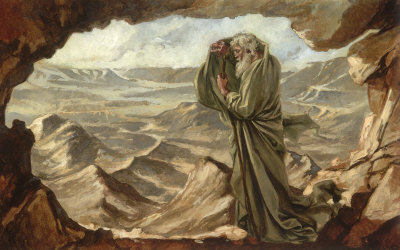
There is something deeply human about the Elijah we meet in the first reading today. Only a short time earlier he had stood on Mount Carmel before King Ahab, the people of Israel, and the prophets of Baal. It had been one of the great dramatic moments of the Old Testament. Elijah had challenged the prophets of Baal to prepare their sacrifice, while he prepared his, and to call upon their god. They shouted, danced and worked themselves into a frenzy from morning until evening. Elijah then quietly rebuilt the altar of the Lord, placed the sacrifice upon it, drenched it with water, and prayed. Fire came down from heaven. The people fell upon their faces and cried out: “The Lord, he is God! The Lord, he is God!”
We might imagine that Elijah would have emerged from such an experience utterly fearless. Yet only a few verses later Queen Jezebel sends word that she intends to kill him, and Elijah runs for his life. He goes south into the wilderness, sits down beneath a broom tree, and tells God that he has had enough. He is exhausted, frightened and disillusioned. An angel gives him food and water, and eventually Elijah makes the long journey to Horeb, the mountain of God, the mountain where Moses had encountered the Lord generations before.
It is there that the Lord asks him a strangely simple question: “What are you doing here, Elijah?”
Perhaps Elijah himself barely knows the answer. He has fled from danger, certainly, but he has also fled from the burden of being Elijah. He has spent years confronting kings, challenging idolatry, warning Israel, defending the covenant. Now he retreats into the cave on Horeb, carrying with him all the noise of what has happened: the threats of Jezebel, the failures of Israel, his fear for his own life, and his conviction that everything has gone wrong.
Then comes that extraordinary scene. A mighty wind tears at the mountain and shatters the rocks. Elijah knows the power of wind; he has seen storms and droughts. Yet the Lord is not in the wind. Then comes an earthquake. The Lord is not in the earthquake. Then fire. Elijah certainly knows fire, because he has just seen the fire of God descend upon Carmel. Yet the Lord is not in the fire. Finally comes what Scripture describes as “a gentle breeze,” or, in another beautiful translation, “the sound of sheer silence.” Elijah covers his face with his cloak and stands at the entrance of the cave. He knows that God is there.
The Carmelite tradition has always loved Elijah for precisely this reason. Carmel looks back to him as the prophet of prayer, solitude and contemplation: the man standing before the living God and learning how to listen. There is something here that our own age badly needs. We live surrounded by voices demanding our attention. News arrives every hour. Phones buzz. Opinions multiply. Anger travels quickly. Every controversy comes with its commentators, every public issue with its slogans and accusations. We can spend an astonishing amount of our lives listening to people shouting.
In a few months we will have local government elections, and the noise will only increase. We already know what much of it will look like: politicians shouting over one another, insults, promises, accusations, slogans, rallies, posters, performances and, occasionally, a fair amount of clowning. It can become exhausting. It can produce cynicism very quickly. We can become so tired of the noise that we begin to withdraw from the whole business.
Elijah gives us another way of approaching the world. He goes into silence so that the voice of God can become clear again. Yet Horeb is preparation. God speaks to Elijah and then sends him back. There is still work for him to do. There are people to anoint, responsibilities to carry, a prophet to call in Elisha, and a nation to serve. The silence of Horeb restores Elijah to his vocation.
Christian prayer does the same for us. We come before God so that our minds, consciences and hearts can be formed by Him. We kneel before the Blessed Sacrament. We come to Holy Mass. We make time for quiet prayer. We open the Scriptures. In that stillness we learn again which voices deserve authority in our lives. Then, strengthened by grace, we return to our families, our work, our communities and our responsibilities as citizens.
This is where our Catholic understanding of public life belongs. The Church has always taught that lay Catholics have a real responsibility for the temporal order and for the common good. Our civic duties form part of our moral life because our neighbour lives within the society we help to shape. Local government affects water, roads, sanitation, housing, safety, public spaces and the daily dignity of ordinary people. Participation in civil society therefore belongs within our concern for our neighbour.
Saint Paul gives us something of that spirit in the second reading. He speaks of his “great sorrow and constant anguish” for his own people. His concern comes from love. He cares deeply about what happens to Israel because these are his people. The Christian concern for our country and our city should have the same character. Love of neighbour gives us a reason to take public life seriously. Voting is one ordinary expression of that responsibility. Over the next few months, Catholics should make sure that they inform themselves carefully, exercise prudence in judging candidates and parties, and then go and vote according to a well-formed conscience and genuine concern for the common good and our neighbour.
The Gospel gives us the same lesson through another character. Peter steps out of the boat because he sees Christ. The wind is already blowing and the sea is already rough. Yet while Peter attends to the Lord, he walks upon the water. Matthew tells us that when Peter becomes aware of the force of the wind, fear takes hold of him and he begins to sink. His attention has been captured by the storm.
How easily that happens to us. Elijah hears Jezebel’s threat until it fills his imagination. Peter feels the wind until it fills his vision. We can allow the noise around us to occupy so much of our attention that we lose our sense of proportion. Prayer restores that proportion. Christ remains Lord even when the wind is strong, the politics is ugly, the future uncertain, and the world noisy. The Cross is steady while the world is turning, as the Carthusian motto goes.
So perhaps there are two simple things to take from the readings this week. First, recover some silence. Find ten minutes in the day when the phone is put away, the television is silent, and you simply place yourself consciously in the presence of God. Pray before the Blessed Sacrament if you can. Let the Lord form your judgment before the world fills your head with its noise. Second, carry that prayer, calm and stillness back into your responsibilities. All of your responsibilities of your daily life and contexts into which the Lord calls you.
At Horeb, Elijah covers his face because he recognises the presence of God. On the lake, the disciples fall before Christ and say, “Truly, you are the Son of God.” That is where our lives must begin again and again: before the Lord, listening to Him, worshipping Him, allowing Him to order our hearts. From there we go back into the world with steadier judgment, greater courage, and a clearer sense of the duties God has placed before us. Amen.