
Isaiah 22:19-23 | Romans 11:33-36 | Matthew 16:13-20
Who is this Shebna in the first reading? He is one of those obscure Old Testament characters whom we meet for only a moment, but who turns out to be rather interesting. Shebna is the “master of the palace” under King Hezekiah, one of the most powerful men in Jerusalem. He controls access to the royal household. He carries authority and enjoys considerable status. Somewhere along the way, he becomes rather impressed with himself.
Just before the passage we hear today, Isaiah finds Shebna cutting an elaborate tomb for himself high in the rock. It is a revealing little detail. A man entrusted with service to the royal household has begun using his position to construct his own importance. Even his burial place is going to tell Jerusalem how important Shebna was. He has confused stewardship with possession. And so God says: “I dismiss you from your office; I remove you from your post.”
Then another man appears: Eliakim, son of Hilkiah. God introduces him very simply: “I call my servant Eliakim.” Eliakim receives Shebna’s robe and sash, and then God says: “I place the key of the House of David on his shoulder; should he open, no one shall close; should he close, no one shall open.” The key is the sign of an office. Eliakim carries something belonging to the king because the king has entrusted his household to him. And Isaiah tells us what this authority is meant to produce: Eliakim is to become “a father to the inhabitants of Jerusalem.” Something has been placed in his hands for the good of others.
That contrast between Shebna and Eliakim prepares us beautifully for the Gospel, because before Peter answers Jesus’ famous question, the Gospels have already introduced another man trying to work out who Jesus is: Herod Antipas. Matthew tells us that Herod hears about Jesus and concludes that he must be John the Baptist raised from the dead. But Mark gives us the fuller picture. People are saying: “John the Baptist has been raised from the dead.” Others say: “He is Elijah”; others again, “He is one of the prophets.” Then, two chapters later, Jesus asks his disciples at Caesarea Philippi: “Who do people say that I am?” And they give almost exactly the same answers: John the Baptist, Elijah, one of the prophets. Herod and Peter are presented with essentially the same information. And they travel in very different directions.
Mark tells us something fascinating about Herod. He feared John because he knew him to be “a righteous and holy man.” He was perplexed by John, and yet he liked listening to him. Herod is interested. He is curious. He even recognises something holy when he encounters it.
Then John touches the part of Herod’s life that requires conversion. John challenges his relationship with Herodias. Later comes the banquet, the dancing, the foolish oath and the request for John’s head. Herod is deeply distressed, yet his guests are watching. His reputation is at stake. The shame of backing down becomes unbearable to him, and John is killed. Herod hears the truth and allows vanity to decide what he will do with it.
Peter has weaknesses of his own. He is impulsive, frequently confused, sometimes overconfident. Yet Peter has one great advantage: he keeps allowing Jesus to lead him. He has left his nets. He listens. He asks questions. He gets things wrong and stays close enough to be corrected.
The difference lies in disposition. Herod protects the life he has constructed for himself. Peter gradually allows Christ to reconstruct his life.
And look where Peter makes his confession: Caesarea Philippi. The place itself is almost another character in the story. Long before Philip built his city there, the site was associated with the pagan sanctuary of Pan. Herod the Great had added a sanctuary connected with Augustus. Then his son Philip developed the settlement into his capital and named it Caesarea Philippi: Caesar’s name and Philip’s name written across the landscape. Another monument to human power and human importance.
Shebna has his tomb. Herod has his reputation. Philip has his city. And in the middle of all these monuments to human importance stands a fisherman from Galilee who says: “You are the Christ, the Son of the living God.” Jesus replies: “Blessed are you, Simon son of Jonah, because flesh and blood has not revealed this to you, but my Father in heaven.”
That is important. Peter’s confession is already the work of grace.
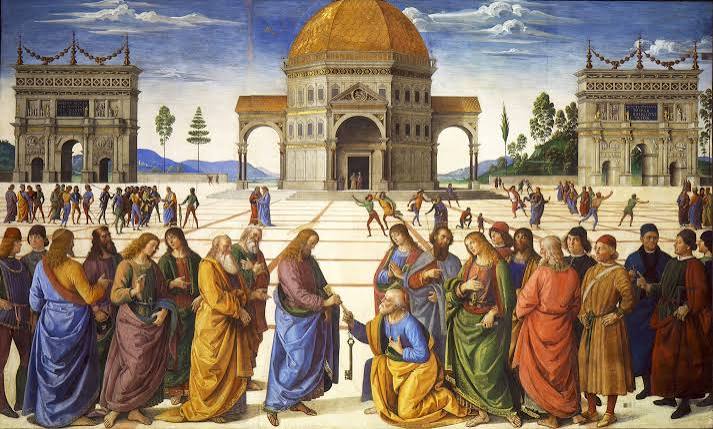
Then Jesus gives him the keys. The image from Isaiah appears again. Eliakim received the key of the House of David; Peter receives the keys of the kingdom of heaven. Something belonging to the King has been placed into his hands. Peter will spend the rest of his life learning how to carry it.
Within a few verses he will misunderstand Jesus when he speaks about the Cross. During the Passion he will deny him three times. After the Resurrection Christ will seek him out, restore him, and entrust the flock to him again. Grace calls Peter, corrects him, restores him, and gradually forms him into the steward Christ intends him to be.
And perhaps that is where all these characters finally come home to us. What has God placed in my hands? A marriage. Children. A profession. Money. Education. Authority. Responsibility for employees. A friendship. A gift that can help others. Some responsibility in the Church or in the wider community. Our lives are full of things entrusted to us.
Shebna reminds us how easily stewardship can become self-importance. We see the same temptation whenever public office becomes a means of enriching oneself, rewarding friends, protecting status, or building a personal empire. Communities suffer when things entrusted for service are treated as private possessions. And the temptation comes much closer to home as well. My position, my gifts, my influence, even the people I love can gradually become part of the little monument I am constructing to myself.
The disciple learns another way. Eliakim receives the key as a servant. Peter receives the keys through grace. And Peter keeps allowing the Lord to form him into someone capable of carrying what has been entrusted to him. That is Christian stewardship. So perhaps our prayer today can be very simple: Lord, make me a good steward of what you have placed in my hands. Give me the humility to receive it as gift, the courage to change when you challenge me, and the grace to use it faithfully in your service and for the good of those you have entrusted to me. Amen.