
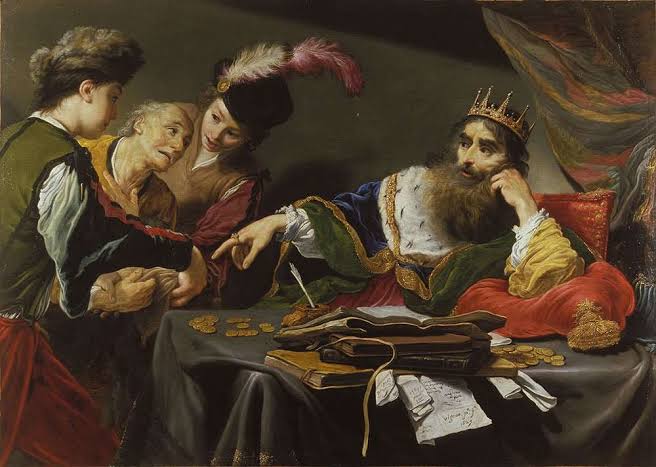
Who is the man who stands before the King in today’s parable?
Jesus tells us that he owes the King an unimaginable amount — many lifetimes’ worth of income.
And yet, when he is brought before the King, he falls to his knees and says:
“Give me time, and I will pay the whole sum.”
But he can’t.
That is the point. There isn’t enough time. There is nothing this man can do to settle the account.
While he asks the King for time, the King gives him mercy.
“The master felt so sorry for him that he let him go and cancelled the debt.”
Everything.
Gone.
Who is this man?
One of the first movements of the Christian life is to recognise ourselves standing where he stands.
We live in a world wounded by sin, and we add to that inheritance with sins of our own. Hence the first proclamation of the Gospel is so often:
“Repent and believe.”
And we have already done something like that this morning.
At the beginning of Mass we stood before God and said:
“I confess to Almighty God… that I have greatly sinned.”
And then:
“Lord, have mercy.”
Perhaps we remember kneeling in the confessional:
“Bless me, Father, for I have sinned.”
And there we name things we cannot undo. Words we cannot take back. Choices we cannot make never to have happened.
And then we hear:
“I absolve you from your sins.”
Or perhaps, at the end of the day, alone in the quiet of our room, we become aware again of our weakness and simply say:
“Lord, have mercy.”
To be a Christian is to know what it means to stand before the King with empty hands.
We cannot buy our way out. We cannot undo the past. We cannot make ourselves innocent.
We ask for time.
And God gives us mercy.
But then something extraordinary happens in the parable.
The servant leaves the presence of the King and meets someone who owes him a debt.
Suddenly, the man who had been standing before the King finds himself standing, in a sense, in the place of the King.
Someone else is now before him.
Someone else owes him.
Someone else falls down and begs:
“Give me time, and I will pay you.”
They are almost exactly the same words he himself had spoken only moments before.
And perhaps this is where the parable becomes uncomfortable.
Because the question is no longer simply:
What does it mean to stand before the King?
It becomes:
What does it mean to stand in the place of the King?
The servant had seen the heart of the King.
He knew what the King was like because he had experienced it for himself.
He had stood guilty before him — and encountered mercy.
And now another person stands before him.
This was his opportunity to make the heart of the King visible.
The King had cancelled an impossible debt.
Could something of that mercy now pass through him?
Could the man standing before him discover, through this servant, what the King was like?
That is the tragedy of the parable.
The servant does not merely fail to imitate the King.
He fails to make present the heart of the King.
The mercy that had reached him goes no further.
And so the Kingdom remains hidden.
That does not mean that the wounds people inflict upon us are unreal.
Sirach knows very well about wrath and anger. Some injuries run very deep. Forgiveness does not mean pretending that nothing happened. It does not mean that we can simply decide not to feel hurt. It does not always mean that a relationship can or should return to what it was before.
But it does mean that the mercy we have received cannot simply end with us.
Saint Paul tells us today:
“The life and death of each of us has its influence on others.”
None of us lives only for himself.
Even the way we carry the wounds others have caused us can have an influence.
Perhaps, in some cases, all we can yet do is pray for the person who has hurt us.
Perhaps we can say:
“Lord, I cannot change how I feel. I cannot undo what happened. I may not even be able to be close to this person again.
But I place them before you.
Have mercy on them as you have had mercy on me.”
That prayer already begins to allow the mercy of the King to pass through us.
Every time we come to Mass, every time we go to Confession, every time we say “Lord, have mercy,” we stand again before the King.
We remember what it is to owe what we cannot repay.
We remember what it is to receive what we could never earn.
And then we go out.
And sooner or later someone stands before us.
Someone who has failed us.
Someone who owes us an apology.
Someone who has wounded us.
Someone whose debt to us may be very real.
And in that moment, the question of the Gospel is placed before us again:
Having stood before the King, what will it mean now to stand in the place of the King?
Will the mercy we have received stop with us?
Or will the heart of the King become visible through us?
We stand before the King.
And then we stand before others.
And perhaps this is one of the deepest vocations of the Christian life:
to make visible the heart of the King, and so to make present his Kingdom. Amen.