
Are you ready?
Sunday marked 47 days until Christmas! The year is rapidly coming to its close. As this happens, we notice that the readings at Mass become a little more sombre. Our thoughts are directed towards those things which we call the Four Last Things: death, judgement, heaven and hell. These are not always comfortable things to think about, but they are things for which every Christian must be prepared.
It’s additionally fitting that we should hear these readings in November, the month in which the Church prays particularly for the Holy Souls in Purgatory. This coming Wednesday, 11 November, we will also remember those who lost their lives in the wars of the world. And even St Paul, in the Second Reading today, speaks about the dead, and the hope which belongs to us as Christians. We do not mourn as the pagans do, as those who have no hope, because we believe in the victory of Jesus Christ over sin and death.
And it is against this background that we hear the rather striking parable of the ten virgins in today’s Gospel. The traditional interpretation of this parable is that these virgins represent us, the members of the Church, waiting for the return of the Lord Jesus, Who will, as we say every Sunday in the Creed, come again to judge the living and the dead. All ten virgins are waiting for the bridegroom. All ten have lamps, and all ten have some oil. But there is a very important difference between them. Five have come prepared with a reserve of oil, while the other five have brought only enough for the present moment.
The wise virgins have both an external light, visible to everybody, and an internal reserve from which that light can continue to be fed. The foolish virgins have the present illumination of their lamps, but have given no thought to the darkness which might lie ahead.
Because it is true, isn’t it, that life can become difficult? There are moments when our faith seems strong, when prayer comes easily, when we are quite certain of the Lord’s presence in our lives. Our lamp is burning brightly. But there are other moments when things become much more difficult: when prayer seems dry, when temptation becomes stronger, when suffering comes unexpectedly, or when we feel that the Lord has delayed His coming and the powers of darkness are closing in.
It is not enough, then, to be ready for a little while. We must, with God’s help, be ready for what lies ahead. We must be prepared not only for the final coming of the Lord, but also for those difficult spiritual moments which we cannot yet foresee.
We need to fill the reserve. Or rather, we need the Lord to fill what He has created.
Where does this “oil” come from? The First Reading gives us a rather beautiful answer. It speaks of Holy Wisdom, who is not far away from us, or difficult to find, but who actually comes looking for us. Wisdom is there at dawn, waiting at our gates, eager to make herself known to those who seek her. And this Wisdom is something much greater than the accumulation of worldly knowledge, or a collection of wise sayings. In the Christian understanding, we recognise here something of the very presence and life of God Himself. We recognise especially the Divine Son, the eternal Word and Wisdom of the Father, Who has taken flesh and dwelt amongst us. The Lord does not simply command us to be ready and then leave us to make ourselves ready. He has already come to us. In His first coming, in His Incarnation, His Passion and His Resurrection, He has opened for us the treasury of divine grace. And He continues to give us His own life, not only for the present moment, for the here and now, but also for those moments which are still to come.
We need not rely simply upon our own strength. We can draw upon the grace of God, received and treasured up within us. And a full reserve will make us ready for anything.
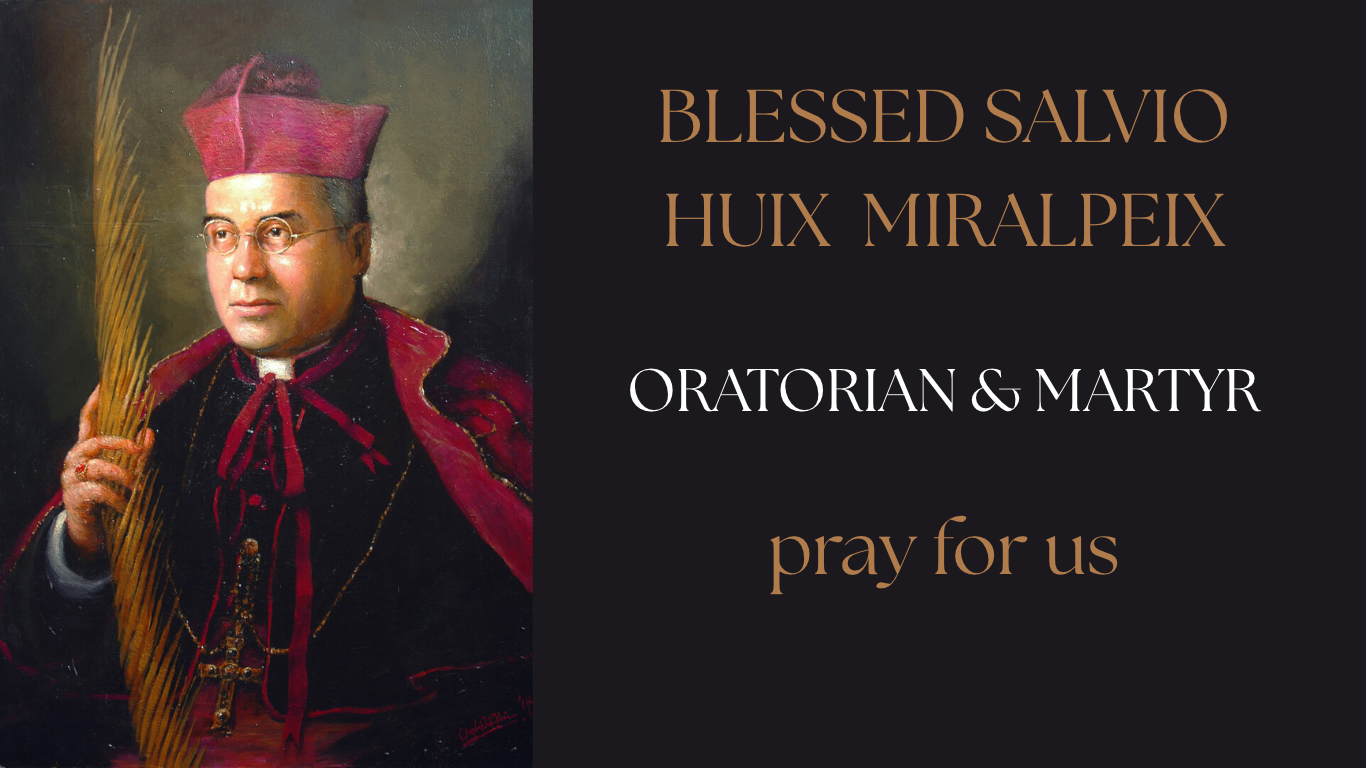
We had a rather beautiful example of this in the life of one of our own Oratorian Blesseds, whose feast we celebrated on Saturday: Blessed Salvio Huix, a Catalan Oratorian priest who became a bishop and was martyred during the Spanish Civil War. When he was imprisoned with others who were facing death, he continued to minister to them. And when they were taken out to be executed, he asked that he might be the last to die, so that he could bless and comfort the others. When he was shot through his right hand to prevent him from blessing them, he simply continued to bless them with his left.
That kind of courage does not ordinarily appear from nowhere, at the last moment. It is the fruit of a life already given to God, a life in which the reserve has been filled, little by little, through prayer, through sacrifice, through fidelity to grace. When the moment of darkness came, Blessed Salvio had something upon which to draw. And perhaps this brings us to a very practical question. How are we filling our own reserves? How are we allowing the Lord to prepare us for those things which we do not yet know are coming?
We could suggest three rather simple things.
FREQUENT SACRAMENTS
First, the frequent reception of the sacraments, and especially the Sacrament of Confession. It is a very wise thing to go to Confession regularly! We should not wait until something has gone terribly wrong before approaching the Lord’s mercy. Confession restores and strengthens the life of grace within us. It is one of those ordinary ways in which the Lord prepares us for extraordinary difficulties. We would be foolish to miss out on this relatively ordinary occasion in which the Lord provides extraordinary grace. We may have some surmountable obstacles in our mind to confession; we may think it too difficult, or we doubt its importance. It’s not an optional extra, but the authentic way a Christian becomes ready for the coming of the Lord at Mass, and at the end of time.
DAILY SACRIFICES
Secondly, our daily sacrifices, like we do in Holy Lent. These need not always be great physical penances. Sometimes the more difficult sacrifice is to give up our desire to be right, to have the last word, or to insist upon our own way. Every little act of self-denial, every occasion on which we choose the will of God rather than our own, makes us more ready to follow Him when greater sacrifices are demanded of us. They unite us to that Great Sacrifice of the Lord on the Cross and in the Mass; our ordinary experiences are transformed into something that fills up that spiritual reserve within us; we decrease, and the Lord allows us to increase. We are spent, but the Lord fills us up. A life without these sacrifices is not a really Catholic life.
SMALL ACTS OF MERCY
And thirdly, charity, especially in this month of November, charity, especially towards the dead. The Holy Souls can no longer do for themselves what we can still do for them. Our prayers, our sacrifices and above all the offering of Holy Mass are great works of mercy on their behalf. And in praying for the dead, we are reminded of our own mortality, and of the hope which Christ has won for us. And of His love for us, even when we’re separated from those we love by the certainty of dying.
ALL IN ONE?
In fact, this coming Wednesday we have a rather beautiful opportunity to do all three of these things together, at our Solemn Requiem Mass for the Dead of the Oratory. We can draw upon the grace of the sacraments, make the small sacrifice of our time to be there, and perform that great spiritual work of mercy of praying for those who have gone before us who ministered to us. Be sure that priests need your daily prayers; priests in purgatory need your prayers still. So, do join us for this offering for the Fathers and Brothers who have died.
As the Church’s year draws towards its end, let us ask ourselves again the question with which we began: Are you ready? We can’t simply be ready for today, when the lamp is burning brightly, but ready also for tomorrow, when the night may be longer than we expect. Let us ask the Lord to fill that reserve within us, so that whenever He comes, and whatever darkness we may have to face before then, He may find us ready to welcome Him with joy – and He to welcome us into the Halls of Heaven. Amen.