
9 & 10 May 2026, 6th SUNDAY OF EASTER
In the Gospel today, Jesus says something deeply consoling: “I will not leave you desolate.” Desolate, in other translations is given as “orphaned” – “I will not leave you orphaned”.
Those words lie at the heart of all the readings this Sunday. They are spoken on the night before the Passion, as Jesus prepares his disciples for his departure. The disciples are anxious, confused, uncertain about what will happen next. They have built their lives around him. And now he speaks about going away.
“Orphaned” or “desolate” evokes a sense of abandonment. Jesus speaks directly to that human fear of isolation, of being left alone. He speaks of communion. “I will ask the Father,” he says, “and he will give you another Advocate to be with you forever.” The great theme running through today’s readings is this: through the Holy Spirit, the Risen Christ continues to dwell with and nurture his people through the communion of the Church.
And providentially, this theme intersects beautifully with Mothers’ Day. (We wish all of the mothers a very happy Mothers’ Day). At its deepest level, motherhood reflects something essential about the way God loves his people: God creates life, nurtures life, protects life, sacrifices for life, and remains faithfully present to those he loves. Human motherhood participates in that divine pattern.
Now of course, Mother’s Day can be emotionally complicated. For some it is joyful. For others it carries grief, regret, bereavement, or difficult relationships. But even amid human imperfection, motherhood remains one of the clearest earthly signs of the nurturing, life-giving love of God. Our modern world often struggles to understand the dignity and spiritual significance of motherhood. Perhaps we tend to measure value according to productivity, status, income, independence, or public achievement. In that sense, motherhood can then be reduced merely to biology or domestic labour or, at best, sentimental affection. Scripture sees motherhood differently. Motherhood stands close to the mystery of God himself because motherhood is about receiving life, protecting life, forming life, and giving oneself away so that another may flourish.
And is that not exactly what Jesus promises in today’s Gospel? “I will not leave you orphaned.” Christ does not save us from a distance. He enters into creation, walks amongst us, and, even after he ascends to heave, through the Holy Spirit, he continues to accompany, nourish, teach, correct, strengthen, and sustain his people, which is His Body. The Church, the Body of Christ, herself becomes motherly. This is why the Church has always spoken of “Holy Mother Church.” The Church gives birth through Baptism. She nourishes through the Eucharist. She teaches through the Gospel. She heals through Reconciliation. She strengthens through Confirmation. She accompanies her children through suffering and death. The maternal life of the Church flows from the maternal tenderness of God himself.
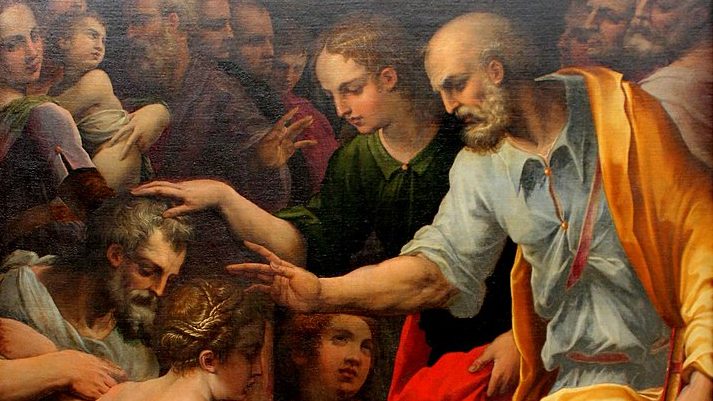
We see that dynamic already unfolding in today’s first reading from Acts of the Apostles. Philip preaches in Samaria and many come to believe. There is joy, healing, conversion. But then Peter and John come from Jerusalem and lay hands upon the believers so that they may receive the Holy Spirit. Why is this significant? Because Christianity is not an individual spiritual experience. God gathers us into a family. The Spirit forms communion. The apostles nurture and strengthen the new believers so that they may grow into mature Christian life. There is something profoundly parental, even maternal, in this action of the Church. The newly baptised are not abandoned after conversion. They are accompanied, strengthened, and incorporated into a living community. Each of us, as members of the Body, is called both to experience that maternal care, as well as manifest it in our own lives in the way we treat others, especially those in the Christian community.
And perhaps that is especially important today because we live in an increasingly orphaned culture. Not merely in the literal sense, though tragically many children do suffer abandonment; but spiritually and emotionally. Many people feel disconnected, rootless, anxious, unsupported. We have more technology than ever, yet often less belonging. Many know information, but do not know love. Many have contact, but not communion. Into that loneliness, Jesus says: “I will not leave you orphaned.” That promise is fulfilled in us, the Church, through the action of the Holy Spirit and our co-operation with that grace, striving to be a fitting image and experience of the love of Christ to others.
Another point we notice in the gospel is how Jesus says, “If you love me, you will keep my commandments.” The commandments flow from relationship. Love comes first. Communion comes first. Too often people imagine holiness as merely rule-following or moral effort. But obedience is not servile fear; it is the response of love to the One who first loved us. We are loved, so we show love. Here again we can see the connection to motherhood. The best mothers do not simply enforce rules mechanically. A mother forms the heart. She teaches love, trust, sacrifice, patience, forgiveness, and tenderness. She shapes the inner world of the child so that goodness may eventually arise freely from within. That is what the Holy Spirit does in the Christian soul. The Spirit forms Christ within us. And this formation often happens quietly, patiently, sacrificially… just as motherhood often does. As the Body of Christ, as the Church, whatever our vocation, we should seek to manifest that kind of love toward one another.
Some of the holiest work in the world (much of which has a maternal character) is hidden work: comforting a frightened child, preparing meals, enduring exhaustion, praying silently for one’s family, carrying emotional burdens unnoticed, remaining faithful in ordinary acts of love. The world may overlook these things. God does not. In fact, much of the Kingdom of God is built precisely through hidden fidelity. And perhaps that is why motherhood has such deep spiritual power. It mirrors the self-giving love through which God sustains the world.
In today’s second reading from First Epistle of Peter, St Peter tells Christians not to be ashamed if they suffer for the name of Christ. Love always involves sacrifice. To give oneself for another always costs something. Mothers know this instinctively. But the Cross reveals that sacrificial love is not loss alone: it becomes glory. The Resurrection shows that self-giving love is the deepest truth of reality. That means every authentic act of maternal love participates, however imperfectly, in the very life of God. May we, in the coming week, consciously seek to love in this sacrificial, maternal way.
Today, then, we give thanks for mothers: biological mothers, adoptive mothers, grandmothers, spiritual mothers, godmothers, religious sisters, teachers, caregivers, all women who have reflected God’s nurturing love in the lives of others. And we also entrust to God those for whom today is painful: those grieving mothers, grieving children, difficult relationships, infertility, loneliness, or loss. Ultimately every human form of motherhood points beyond itself toward the deeper promise spoken by Christ: “I will not leave you orphaned.”
In the Holy Spirit, the Risen Christ remains with his Church. He accompanies us. He forms us. He nourishes us. He teaches us to love. And through the maternal life of the Church, he continues to gather humanity into the family of God. An may Our Lady intercede for all mothers in our parish as we give thanks for their vocation. Amen.