
10 & 11 January 2026, FEAST OF THE BAPTISM OF THE LORD
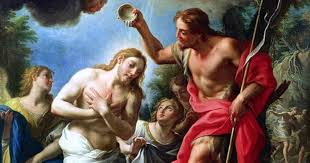
The feast of the Baptism of the Lord, in a way, brings the Christmas season to a close. The crib is still up until the Feast of the Presentation of the Lord (and in our Diocese, we get the “extra” Christmas Feast of Our Lady of the Flight into Egypt at the beginning of February, which is our patronal feast), but tomorrow, liturgically, we exit the Christmas season and enter the Ordinary Time between Christmas and Lent. Today’s feast feels then both like an ending as well as a beginning. Something new begins here. Jesus steps out of the hidden life of Nazareth and into the waters of the Jordan. He steps, too, into public view, into mission, into the long road that will lead to the cross.
The Church has long understood three moments in the Gospel as a single unfolding “Epiphany”: three manifestations of who Jesus truly is. In the visit of the Magi (which we celebrated last Sunday), Christ is revealed to the nations: the Gentiles are drawn by the light, and the child is shown to be King and Saviour for all peoples. In his baptism in the Jordan, Jesus is revealed as the beloved Son of the Father, anointed by the Spirit and publicly named by the heavenly voice. At Cana, in the first of his signs, he reveals his glory through the transformation of water into wine, and his disciples begin to believe in him. Taken together, these events are not isolated stories but a single theological movement: Christ made known to the world, to Israel, and to the Church. A progressive unveiling of the mystery of the Word made flesh.
At the Jordan, who Jesus is revealed, as well as the kind of Messiah he chooses to be. John is preaching a baptism of repentance (not the sacramental baptism we know in the Church today, but a prophetic act of conversion, a sign of turning back to God and longing for new life). People come with their failures, their compromises, their hunger for a fresh start. And into that line steps Jesus. That is the scandal of this feast. The sinless one stands shoulder to shoulder with sinners. The beloved Son stands among those who know themselves to be far from worthy.
The Gospels make clear that this is not accidental. John protests. Jesus insists. And in that insistence, we glimpse the heart of his mission: he will not save us from a distance. He will not call us out of the water while keeping his own feet dry, as it were. He chooses to be where we are and to stand in solidarity with us precisely at the point of our need for conversion. Jesus does not merely sympathise with human weakness; he enters it. He immerses himself in the reality of our condition, with all its fragility and disorder. In doing so, he reveals the character of God. The pattern of salvation shows a God with us, compassionate to us, abiding amongst us.
There is a further depth here. Jesus’ baptism is not only an act of solidarity; it is also a sign of what is to come. Later in the Gospel, he will speak of another baptism with which he must be baptised, and of the anguish that lies ahead as he begins to predict his Passion. The Church has always read those two “baptisms” together as belonging to one single saving mission. The baptism in the Jordan is the beginning of the path that leads to Calvary. In the Jordan, Jesus anticipates the Cross. The descent into the Jordan anticipates the descent into death. In the river, he stands among sinners. On the cross, he takes upon himself the weight of sin. In the Jordan, he symbolically enters the water with us. On Calvary, he enters fully into suffering, abandonment, and death. God speaks his words over Jesus “This is my beloved Son…” and this Word comes to its fulfilment when God raises Jesus from the tomb.
So Jesus baptism shed a light our own. In our baptism, we were not merely welcomed into a community or given a religious identity. We were plunged into Christ’s death and raised with him to new life. We were drawn into his relationship with the Father. The words spoken over Jesus are, by grace, spoken over us: beloved, pleasing in God’s sight, claimed not because of our merits but because we now belong to Christ.
What does this mean for us?
Firstly, it has practical implications for the way we live our faith. We do not need to pretend before God or to curate a respectable version of ourselves in prayer. We come as we are: distracted, inconsistent, hopeful, ashamed, grateful, confused. The Jordan is full of ordinary people with ordinary sins. And it is there that Christ chooses to stand.
We often have the idea that we need to be perfect before approaching God, or to have solved our problems and overcome our sins before going to confession. But, no. God is not drawn only to our strengths, our achievements, or a polished spirituality. God comes to meet us precisely in the places we would prefer to hide. Our repentance, our brokenness, our ongoing struggle against selfishness are not obstacles to grace. They are the very place where grace chooses to work most deeply. This should encourage us in the moments of feeling like we cannot approach God, that it is those very moments where we will encounter Him most profoundly. This a consolation to us because it means our dignity does not rest on our success, our virtue, or our consistency. We remain beloved even in our weakness.
The call of this feast is simple: bring to Christ the parts of your life that you would rather avoid. Bring the habits that trouble your conscience. Bring the relationships that weigh on you. Bring the patterns you feel stuck in. Bring the anger, the envy, the compromises, the regrets. And bring them especially into the sacrament of confession. Confession is not for people who have reached a certain level of holiness. It is for people who know they need mercy, like those who came to John at the Jordan. It is the place where we stop managing appearances and allow Christ to meet us in truth.
Secondly, this feast is a challenge because baptism is not a private comfort but a commissioning. Jesus emerges from the Jordan and immediately begins his mission: preaching, healing, confronting injustice, calling for repentance. So Baptism leads to vocation. Grace leads to responsibility. And that responsibility is to imitate our Saviour. Our Saviour who is described in the first reading from the prophet Isaiah: one who brings justice quietly, who does not break the bruised reed or quench the smouldering wick, who opens blind eyes and frees prisoners from darkness. This is the kind of mission that flows from baptism: gentle fidelity to the wounded and the forgotten. To be baptised into Christ is to be drawn into that same pattern of life.
In this Ordinary Time between now and Lent (which used to simply be called the “time after the Epiphany), we are given a precious opportunity to pause and to look honestly at our own lives in the light of what has been revealed about Christ. These weeks are not filler in the Church’s year; they are a space for attention, for prayer, and for examination. They invite us to ask difficult but necessary questions: where does my life reflect the mind and heart of Christ, and where does it resist it? Where am I gentle when I should be, and where have I become hard? Where do I avoid the wounded rather than draw near to them? Where have I allowed comfort, habit, or fear to shape me more than the Gospel?
Lent does not begin in a vacuum. It begins in the soil we prepare now. With just over a month before it arrives, this is the time to begin considering how we will enter it. Not with vague good intentions, but with concrete purpose. What might I need to change? What patterns need confronting? What sins need confessing? What habits of prayer need strengthening? If Lent is to be more than a ritual we endure each year, then this intervening time is its foundation: a season for discernment, for honesty, and for quietly aligning our lives more closely with the life of Christ whom we have been baptised to follow. Amen.