
Today’s Solemnity of All Saints is a rather “different” type of feast. Throughout the year we celebrate – mostly on weekdays – the feast of one or another “saint”, that is a person declared a saint by the Church, which by “canonising” them has made an affirmation both of a person’s virtuous life on earth and of their beatitude in heaven. In other words, a statement that a person has arrived at the destination of their Christian pilgrimage. We all (please God) have saints special to us in some way, whether or not it is Saint Bernadette, our parochial patron, Saint Philip Neri, the founder of the Oratory, Saint Newman, our other Oratorian saint (and now Doctor of the Church) canonised in 2019, or much more recently the Italian teenager Carlo Acutis much beloved by many of our youth. These are examples. Who is your favourite saint? Do you know when his or her feast day is? If not, find out! Today’s feast includes him or her along with all the canonised saints of the church.
A question: if a saint has his or her own day, why do we need again to celebrate them all together on All Saints’ Day? Isn’t that a sort of duplication? Well, no one is in heaven purely as in individual; we commonly speak of a heavenly “company” of the saints. Each of the blessed in heaven is not in his or her own private “cubicle” (so to speak) but enjoys the beatific vision in the blessed union of the whole “company” of heaven; together, they adore the Divine Majesty.
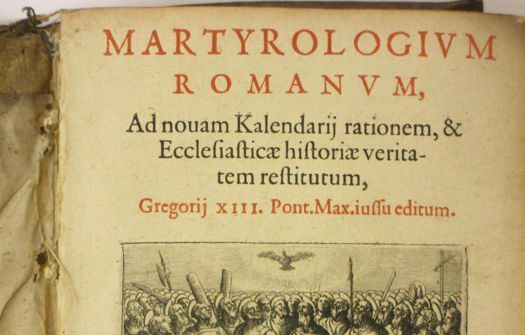
Interestingly, this year a new “Martyrology” is being published by the Church containing the full list of those officially canonised or beatified by the church. It will contain roughly 10,000 names. 10,000? Is that the limit of those in heaven? No. Today’s first reading (from the book of Revelation) speaks of numbers, ultimately speaking of a “great multitude which no man could number” who enjoy heavenly beatitude. So yes – the Church beatifies and canonises certain particular persons (the canonised saints) to put them forward as true models of a Christian Faith and Love and invites us also to ask for their prayers (this is an important feature of today’s feast – do not forget to pray to the saints!) but today’s feast day goes far wider than the canonised saints. For this feast includes all those who have attained to heavenly beatitude, including all our loved ones who may have passed through the purifying fire of God’s love to enter into his closer presence. The Church today allows (commands!) us to honour all those we have loved and venerated on their earthly pilgrimage as true and holy Christians who may now enjoy eternal life with God. Today is a really special feast as it unites us through Faith and Hope but also in Love to everyone who has passed from our midst into the eternal and heavenly Jerusalem.
We soon realise then this feast is not just about the saints in heaven. In Christianity there is no such sharp division. The communion of the saints, the Mystical Body of Christ, means that we form one single church communion uniting heaven and earth and those in the purifying state of purgatory. Whilst tomorrow is the commemoration of All Souls set aside specifically to pray for the departed, today’s feast of All Saints already invites us to see all God’s children (including ourselves) as united in Christ at different points in a journey (our journey) that begins on earth but extends into eternity.
On this day, then, the Church cannot but put forward the implications of today’s feast for us ourselves. Yes, to rejoice in the saints and to request their intercession. That is extremely important. But also our Holy Mother the Church exhorts us to live here and now according to that eternal destiny of which the saints have already laid hold. How easy it could be to live our lives as if the saints did not exist and all we have to think about is the here and now. But how wrong that would be! – and how inspiring and wonderful, how hope-giving, on the other hand, is the truth that (like them) we have been called to a better and more perfect life. So the call to “purify ourselves as God is pure” according to the words of the second reading. That may seem a “tall order” but refers to that process of Christian conversion in which we cast off ever more the evil of sin and allow (by prayer and the sacraments especially) the light of Christ to penetrate more and more deeply into our daily lives. That is also the invitation of the Gospel, the Beatitudes, those high ideals in which Jesus calls us to strive for the good of our neighbour and for God’s glory following his example, as we also bear (or take on voluntarily in acts of penance) certain sufferings or deprivations for the sake of the Kingdom of Heaven. For in this way we can live now as God’s children but expect and hope that that this sonship – the truth that we are sons or daughters of God – will be revealed fully, gloriously, joyfully, in the world to come. Then, the worship we now pay God in the Holy Mass will not be in forms and shadows but face to face where united with all our brothers and sisters we will cry out with voice and heart: “Blessing and glory and wisdom and thanksgiving and honour and power and might be to our God for ever and ever.” Amen.