
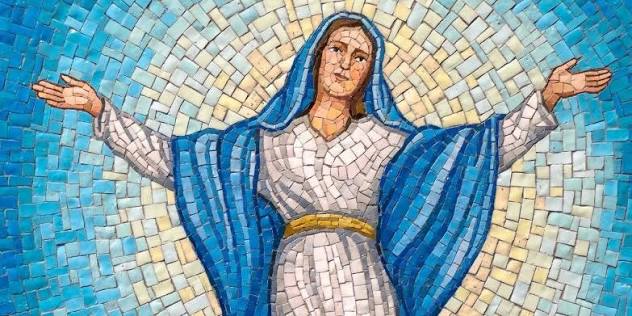
Today, the Church presents us with two extraordinary images of the same woman.
In the first reading from Revelation, we see “a woman clothed with the sun, with the moon under her feet, and on her head a crown of twelve stars” (Rev 12:1).
And then, in the Gospel, we see a very different image: a young woman walking through the hill country of Judea (Lk 1:39). She is pregnant. Her life has been turned upside down by the yes she has given to God: “Let it be done to me according to your word” (Lk 1:38).
The woman walking through the hill country and the woman clothed with the sun are the same woman: Mary.
But Mary, walking through the hill country, cannot see the future.
She cannot see Bethlehem, Egypt or Nazareth. She cannot see Calvary or Easter. She certainly cannot see her Assumption.
Her yes to God has not given her certainty about what lies ahead. If anything, it has left her with more questions than answers.
What will Joseph say? What will other people think? Where will this child lead her? What will her yes cost?
And yet Mary sings:
“My soul magnifies the Lord, and my spirit rejoices in God my Saviour” (Lk 1:46–47).
The Magnificat is astonishing because almost nothing has worked out yet.
We tend to praise God when things work out. The diagnosis comes back clear. The prayer is answered. The door opens. The rains finally come. And instinctively we say, “Thank God!”
And rightly so.
But Mary praises God before she knows how anything will work out.
Why?
Perhaps because Mary’s certainty is not about her future. Her certainty is about God.
“He has looked upon his servant in her lowliness.”
“The Almighty has done great things for me.”
“His mercy is from generation to generation.”
She cannot see where the road leads, but she knows that God is with her.
Perhaps we sometimes expect faith to work differently. We say yes to God and expect things to become clearer. Surely, if I am doing God’s will, the doors should open. Surely there should be some confirmation. Surely God will protect me.
But Mary’s yes does not make her life more predictable. It opens her life to the unknown.
And perhaps that should not surprise us, because something similar is true of every great yes of faith, hope and love.
When two people marry, they say yes without knowing what the next forty or fifty years will bring. When parents welcome a child, they say yes to someone whose future they cannot possibly control. When someone enters the Church, returns to Confession, or makes a deeper commitment to God, there is something of the same surrender: I entrust to God a future I cannot see.
To love is to allow another to change a future we cannot control.
Love fills the heart. And love also makes the heart vulnerable.
Simeon will one day say to Mary, “A sword will pierce your own soul too” (Lk 2:35).
And it will.
Her yes will lead her to joys she could never have imagined. It will also lead her to Calvary.
But today, on the Feast of the Assumption, the Church allows us to see Mary’s life from the other end.
The young woman walking through the hill country becomes the woman clothed with the sun.
Between those two images lies an entire life: Bethlehem, Nazareth, Calvary, Easter.
And St Paul tells us:
“Christ has been raised from the dead, the first fruits of those who have fallen asleep”; and then, “each in his proper order” (1 Cor 15:20, 23).
The Assumption does not reveal only Mary’s destination. It gives us a glimpse of ours.
And perhaps that is particularly important because we are still walking through the hill country of our lives.
Our stories remain unfinished.
We come to Mass carrying unanswered questions, uncertainties, burdens, prayers whose answers we cannot yet see, hopes which may unfold very differently from what we imagined.
And here, rather like Mary and Elizabeth, we come together. We bring those unfinished lives before God. We listen to his Word. We give him our yes. And we sing his praises.
And then something extraordinary happens.
Mary’s yes—“Let it be done to me according to your word”—allowed the Word to take flesh within her.
At Mass, we too will be asked for our yes.
The Body of Christ will be placed before us.
And we will answer:
Amen.
We receive into ourselves the same Christ whom Mary carried through the hill country: Christ who died, Christ who is risen, Christ whom St Paul calls “the first fruits of those who have fallen asleep.”
We do not yet know where our road will lead.
Mary didn’t either.
She could see only the next step, and yet she sang:
“My soul magnifies the Lord.”
Perhaps the question before us on this Feast of the Assumption is simply this:
Can I sing the Magnificat while my own story is still unfinished?
Can I give God my yes—my Amen—and receive Jesus into the uncertainty of my life, trusting that the God who raised Jesus from the dead is still at work in me?
Amen.