
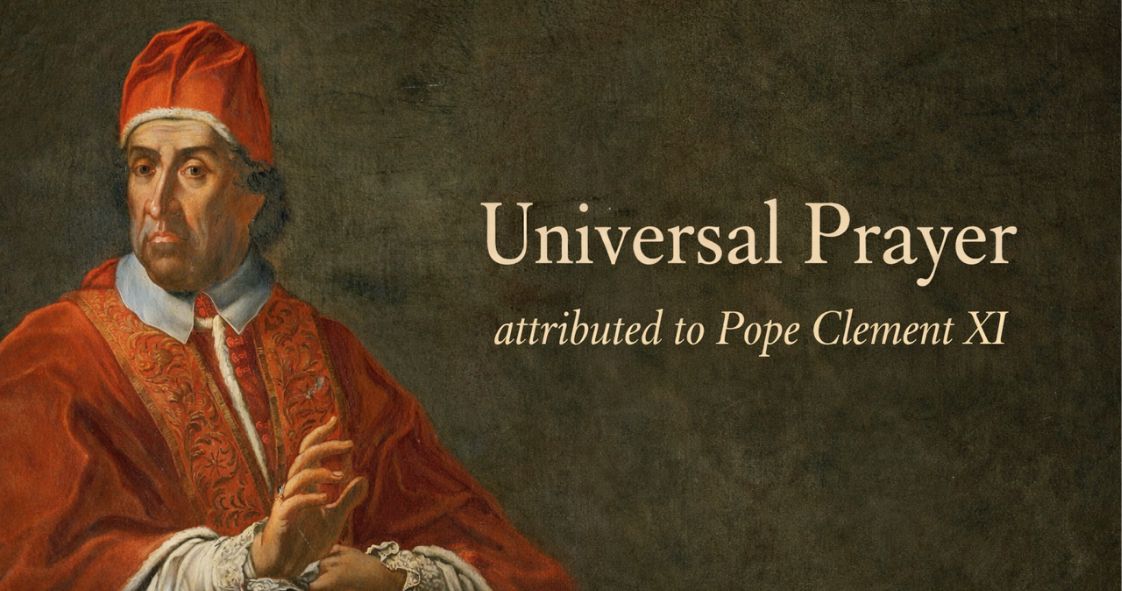
The Universal Prayer (Oratio Universalis) is an historic expression of Catholic piety that has remained popular for centuries. Attributed to Pope Clement XI (1700-1721) it is especially associated with use in thanksgiving after holy communion. Pope St John XXIII highlighted the special value of the prayer: he enriched it with an indulgence, and mentioned it in his Journal of a Soul, stating that he would “make a habit of saying this prayer more often” and citing the Church historian Ludwig Pastor who called the prayer “a monument more lasting than bronze or marble”. After Vatican II – probably considering St John XXIII’s respect for this noble intercessory prayer – it was inserted into the Roman Missal as one of the prayers for “Thanksgiving after Mass” and to this day it is found in the current Roman Missal of 2002/8. (It was omitted for reasons of space at the back of the Sunday Missal used by the laity, which nonetheless includes prayers for use in thanksgiving after receiving holy communion – cf. p. 1140). The Oratio Universalis remains included in the prayers for use after holy communion to which a partial indulgence is attached (Enchiridion Indulgentiarum 1999, 8/2). Recalling the memory of St John XXIII and the words of Benedict XVI that “the precious time of thanksgiving after communion should not be neglected” (Sacramentum Caritatis 50) why not take up this beautiful prayer as a Lenten thanksgiving for the gift of Our Eucharistic Lord? This truly “universal” prayer is however also very suitable for other occasions.
I believe, O Lord, but may I believe more firmly;
I hope, but may I hope more securely;
I love, but may I love more ardently;
I sorrow, but may I sorrow more deeply.
I adore you as my first beginning;
I long for you as my last end;
I praise you as my constant benefactor;
I invoke you as my gracious protector.
By your wisdom direct me,
by your righteousness restrain me,
by your indulgence console me,
by your power protect me.
I offer you, Lord, my thoughts to be directed to you,
my words, to be about you,
my deeds, to respect your will,
my trials, to be endured for you.
I will whatever you will,
I will it because you will it,
I will it in the way you will it,
I will it for as long as you will it.
Lord, enlighten my understanding, I pray:
arouse my will,
cleanse my heart,
sanctify my soul.
May I weep for past sins,
repel future temptations,
correct evil inclinations,
nurture appropriate virtues.
Give me, good God,
love for you, hatred for myself,
zeal for my neighbour,
contempt for the world.
May I strive to obey superiors,
to help those dependent on me,
to have care for my friends,
forgiveness for my enemies.
May I conquer sensuality by austerity,
avarice by generosity,
anger by gentleness,
lukewarmness by fervour.
Render me prudent in planning,
steadfast in dangers,
patient in adversity,
humble in prosperity.
Make me, O Lord, attentive at prayer,
moderate at meals,
diligent in work,
steadfast in intent.
May I be careful to maintain interior innocence,
outward modesty,
exemplary behaviour,
a regular life.
May I be always watchful in subduing nature,
in nourishing grace,
in observing your law,
in winning salvation.
May I learn from you
how precarious are earthly things,
how great divine things,
how fleeting is time,
how lasting things eternal.
Grant that I may prepare for death,
fear judgement,
flee hell,
gain paradise.
Through Christ our Lord.
Amen.
(Translation of the International Commission on English in the Liturgy, 2010)
To see this prayer in the original Latin and in traditional English, please click here.