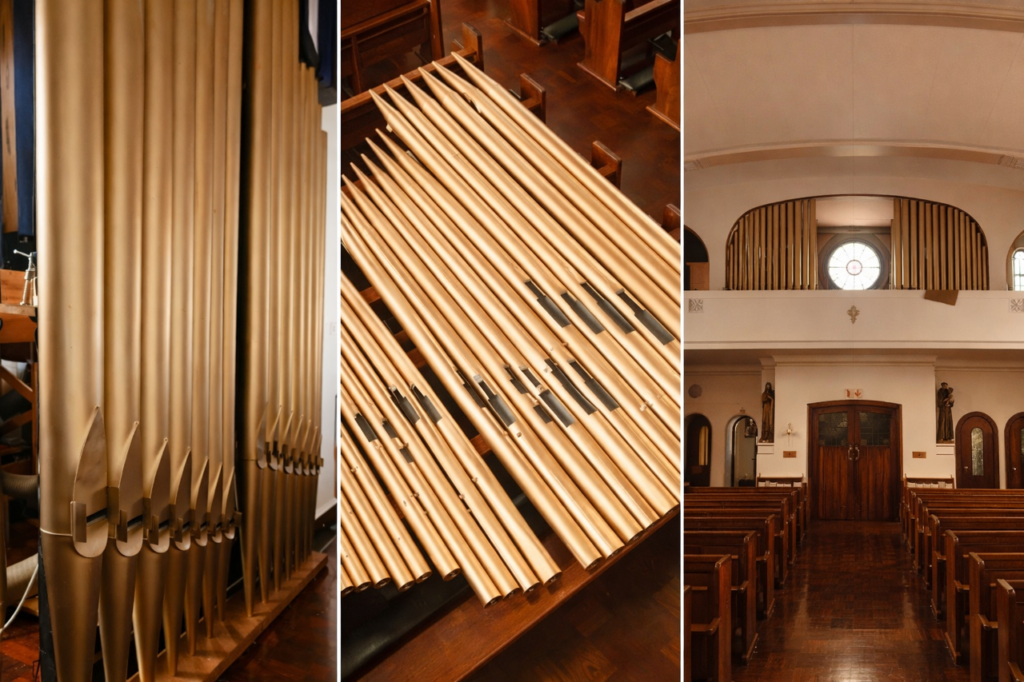
This week we conclude our two part series on the importance of the pipe organ in Church teaching. The organ has been of particular interest in papal and conciliar documents on the Sacred Liturgy, and as the installation of our new pipe organ in St Bernadette’s moves towards its conclusion we consider afresh what the Church teaches in respect of this great instrument which for time immemorial has been integral to Catholic liturgical tradition. This week we look at two remarkable modern statements of the Popes about the pipe organ. “Magno in honore”, the title of our little series, is the Latin expression of the Second Vatican Council in describing this instrument – meaning it is to be “held in great esteem”. Below are some photos showing progress in the work!
Blessing of the New Organ in St. Peter’s in the Vatican (St John XXIII, 1962)
“‘Laudate Dominum in sanctis ejus.’ Praise the Lord in His sanctuary. The Christian populace is led to these thresholds by the sound of the organ. Truly it is the king of sacred musical instruments; and as such it belongs to the temple in a very special way, for it is destined solely for the praises of the Lord. As the sacred rites unfold, it becomes spokesman for the feelings of all, for their noblest and holiest flights. Its melodies make it easier for the mystical movements of the sacred event to penetrate into the depths of the soul: admiration of virtue or desire for it, resolutions of penance and mortification, a longing for a more intimate union with God, a pledge to struggle against evil, a foretaste of the happiness of heaven. In this way the soul opens wide to the mystical influences of grace.”
Blessing of a New Organ at Regensburg’s Alte Kapelle, Germany (Benedict XVI, 2006)
“The organ has always been considered, and rightly so, the king of musical instruments, because it takes up all the sounds of creation – as was just said – and gives resonance to the fullness of human sentiments, from joy to sadness, from praise to lamentation. By transcending the merely human sphere, as all music of quality does, it evokes the divine. The organ’s great range of timbre, from piano through to a thundering fortissimo, makes it an instrument superior to all others. It is capable of echoing and expressing all the experiences of human life. The manifold possibilities of the organ in some way remind us of the immensity and the magnificence of God.
Psalm 150, which we have just heard and interiorly followed, speaks of trumpets and flutes, of harps and zithers, cymbals and drums; all these musical instruments are called to contribute to the praise of the triune God. In an organ, the many pipes and voices must form a unity. If here or there something becomes blocked, if one pipe is out of tune, this may at first be perceptible only to a trained ear. But if more pipes are out of tune, dissonance ensues and the result is unbearable. Also, the pipes of this organ are exposed to variations of temperature and subject to wear. Now, this is an image of our community in the Church. Just as in an organ an expert hand must constantly bring disharmony back to consonance, so we in the Church, in the variety of our gifts and charisms, always need to find anew, through our communion in faith, harmony in the praise of God and in fraternal love. The more we allow ourselves, through the liturgy, to be transformed in Christ, the more we will be capable of transforming the world, radiating Christ’s goodness, his mercy and his love for others.
The great composers, each in his own way, ultimately sought to glorify God by their music. Johann Sebastian Bach wrote above the title of many of his musical compositions the letters S.D.G., Soli Deo Gloria – to God alone be glory. Anton Bruckner also prefaced his compositions with the words: Dem lieben Gott gewidmet – dedicated to the good God. May all those who enter this splendid Basilica, experiencing the magnificence of its architecture and its liturgy, enriched by solemn song and the harmony of this new organ, be brought to the joy of faith. This is my good wish and hope on the day when this new organ is inaugurated.”