
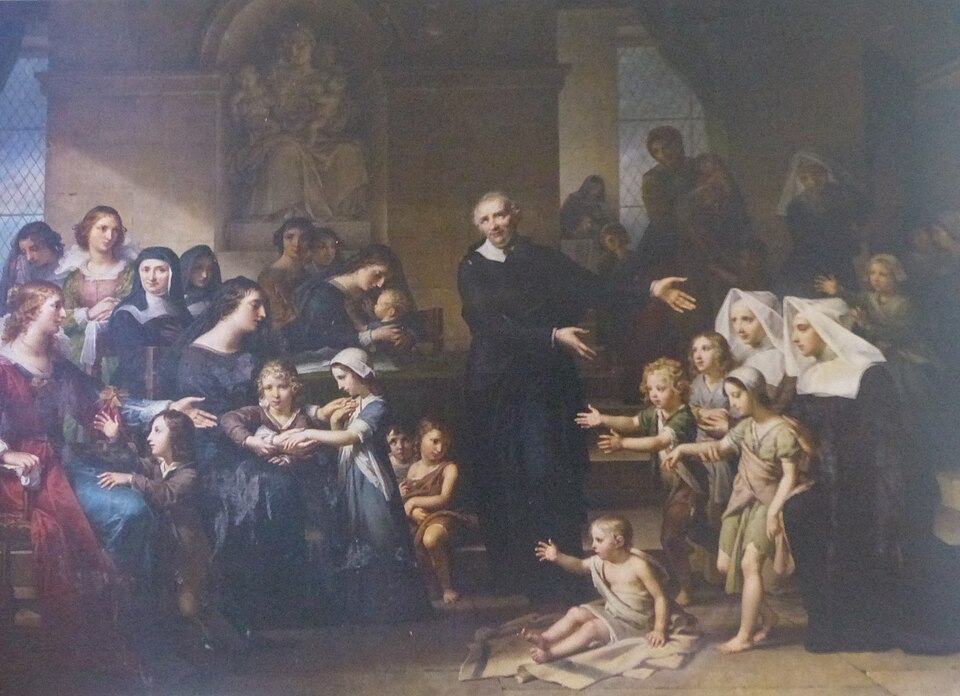
27th September is the memorial of St Vincent de Paul, the 17th century French priest closely associated with the Church’s mission to the poor. This year (on a Sunday, when we don’t usually use the prayers and readings for a saint’s day) let’s look a little bit at this very important saint of modern centuries who has a special relevance for us today. All the more so in the wake of the pontificate of Pope Francis who placed such importance on love for the poor and specifically often (in messages, addresses, encyclicals) spoke of this great saint and invited us to take him as a model and as an intercessor.
A bit of broader history – St Vincent lived a generation or so after that of our own founder St Philip Neri. Vincent was born in Gascony in Southern France in about 1580. St Philip died in 1595 when St Vincent would have been about fifteen, so we’re looking at the period after the turmoil of the Protestant Reformation and a very important period in the history of French church – the seventeenth century – in which numerous reformers and saints transformed the fortunes of the church in that country.
Now let’s first note that we often have St Vincent de Paul in mind because of the Society of St Vincent de Paul which is something much more recent – this Catholic organisation directed at the needs of the poor (and present in our parish) was started in 1833 by (Blessed) Frédéric Ozanam also in France – that is more the epoch of our St Newman – a couple of centuries after St Vincent de Paul. Blessed Ozanam took St Vincent de Paul as patron of his society as Vincent is the great model of Christian compassion for the poor. We pray today therefore especially for our own Society of St Vincent in our parish and for the important work they do.
Now a qualification. St Vincent is rightly honoured as one of the great lovers of Christ in his poor across two millennia of Christian history. Be in no doubt about that. But St Vincent was a truly remarkable priest and saint who was compelled by divine love to respond to whatever need he perceived in the Church of his day. His achievements (by God’s grace) are truly astounding and to read or study his biography is be dazzled by how one man could do so much. A sermon is way too short to give a full account of such a unique life.
I will try nonetheless to look over his life as a whole. As a young man he studied theology being destined for the priesthood – he was ordained in 1600. There is the amazing fact (based on two undisputed letters of Vincent although historians have questioned details) that in 1605 on a sea journey in the Mediterranean he was captured by North African Moslem pirates who took him as a slave to Tunisia for two years. On his own account he reconciled with the Catholic Church a Frenchman who had converted to Islam. This happened because the man’s Moslem wife got chatting to St Vincent in the fields (where he was working) and became convinced that his Faith was true. St Vincent then was in Africa! Some date his concern for the downtrodden and destitute to this remarkable personal experience.
He escaped and returned to France. Now Vincent was not born a saint. It seems he was in fact among those priests (especially of that epoch) who had a rather worldly outlook and was on the look-out for prestigious or well-paid clerical jobs. Circumstances led him to Paris (around 1608) where he came under the influence of Father (later Cardinal) Bérulle who founded what is called the Oratory of France which was based on St Philip Neri’s Oratory (our one here in Port Elizabeth) but different in some ways. Bérulle was a very holy figure and under his direction a change came over Vincent. Vincent (whose natural talents were always observed – he was intelligent and capable) was sent here and there by Bérulle as chaplain to aristocrats and members of the royal family, for parochial duties outside Paris and then later for work with convicts destined for the galleys (prisoners who worked in appalling conditions on ships). Amidst all this a deep compassion began to rise up in Vincent for his suffering neighbour (be they rich or poor) and a desire to serve God as a priest more perfectly in a spirit of Christian sacrifice. The way he began to lavish care and love on the needy started to make a deep impression on people.
Now from his parochial work he realised a great need to renew the Faith among the poorer country people. It is said that hearing a deathbed repentance of a poor peasant made his heart wrench at the spiritual need of humanity (a spiritual destitution?). The key (St Vincent believed) was the better formation of priests. St Vincent under the guidance of French bishops started giving retreats for priestly formation; this developed into seminaries and the formation of the Congregation of the Mission (also called the Lazarists) – priests to do missions for the rural areas. At his death Vincent had the direction of 11 seminaries. (The priests ended up being sent by Vincent not only to France but also Italy, Ireland, Scotland, Poland and Madagascar and also to the slaves in North Africa where Vincent himself once had been). In Paris Vincent began giving open retreats to priests and laity – it is reckoned that participants had numbered around 20,000 over the course of his lifetime – educating the faithful in Christian doctrine and devotion. It was also roughly at this time that Vincent came to know our own St Francis de Sales who gave him a number of important commissions. Next, Vincent formed the Confraternities of Charity, bodies through which (often wealthy) lay women and men participated in an organised way in the Church’s mission to the poor. In 1633 Vincent met (Saint) Louise de Marillac and with her formed what became the Sisters (or Daughters) of Charity, a sort of religious congregation of women entirely devoted to the care of the sick and poor including in the hospitals. The sisters also alongside Vincent undertook the care of foundlings (infants who had been abandoned – a major issue at that time). In all these works Vincent emphasised the human and Christian union of the collaborators: that those who participate in work among the needy must be united amongst themselves, as a founding document of the Confraternity reads: “this good work, once begun, might die out in a short time if [the collaborators] do not have some union and spiritual bond among themselves – to maintain it they have arranged to form [this] association…” In other words, the Confraternity unites the members in Christian love – unites them one with another – and then in the common shared work of the apostolate: the bond of union between them makes their work and apostolate fruitful.
A few interesting facets of the saint. Despite doing so much his collaborators accused him of slowness! In all these works he took his time. They developed gradually. He said: we must first establish a spirit of prayer, we must allow God’s presence to strike root in us. St Vincent was a master of prayer – there is a whole book on the subject. Daily meditation uniting us with God then flows out into love of our neighbour – this was Vincent’s doctrine. Secondly his manner of preaching – perhaps he had learnt from St Francis de Sales the motto that our Newman used – cor ad cor loquitor (heart speaks to heart). Vincent believed in simplicity and (like St Philip Neri) disliked the flowery dramatic preaching common at the time. He preferred a more personal simpler form of communication – speaking from the heart. And both of these are expressive of another virtue – humility. Vincent did so much but he didn’t want to put himself at the forefront but rather allow God to act. He wanted to bring souls to God and himself to remain almost hidden or invisible. A remarkable fact in one who in fact became so renowned. Pope Francis summed up all this (in his Encylical Dilexit Nos) by quoting a French author about St Vincent: “when our Lord dwells in a heart, he gives it such sentiments, and this heart reaches out to the least of our brothers and sisters. Such was the heart of Saint Vincent de Paul … When our Lord lives in the soul of a priest, he makes him reach out to the poor.”
That same author (Abbé Henri Huvelin) tells us in his book that when St Vincent was due to be canonised (1737) there were objections! That Vincent had sat on the Royal Council making appointments of bishops and so on (it worked like that at the time) hobnobbing with certain high state officials known not to be living very moral lives. An objection a bit like Our Lord eating with tax collectors and sinners. Note! Again, Vincent is known for his work with the poor, and rightly so. But he was so totally open to the divine call that he did whatever obedience led him to – right up to the chambers of state – for the good and service of Christ’s Church. His influence led to excellent bishops being appointed – his influence over French society went from high to low and touched people of every background.
There is one more story I can’t resist telling you. When the so-called Thirty Years War in Europe in the mid-17th century touched parts of France, Vincent (typically) mustered support from his groups to send financial support to stricken areas. Vincent himself penned the soup recipes to be used in feeding the poverty-stricken (with details of quantities of fat and salt etc.) to be used in these projects. That little fact tells you a lot. He was practical; he believed that the relief of need should be organised and planned; and he desired not just that the destitute eat but they eat well – this is a delicate and touching charity.
Today’s readings aptly sum up much of our saint. Ezekiel’s prophecy points forward to Christian repentance and conversion, the foundation – both for himself and others – of Vincent’s mission. The second reading from Philippians describes the humility of Jesus Christ who took the lowest place to save humanity, and St Vincent after this example humbled himself in the service of the poor, for their good both spiritual and material. And Vincent – according to God’s time not his – was not the man to say yes then do nothing about it. Often not in many words, but rather in action Vincent was a true servant of Christ. Amen.