
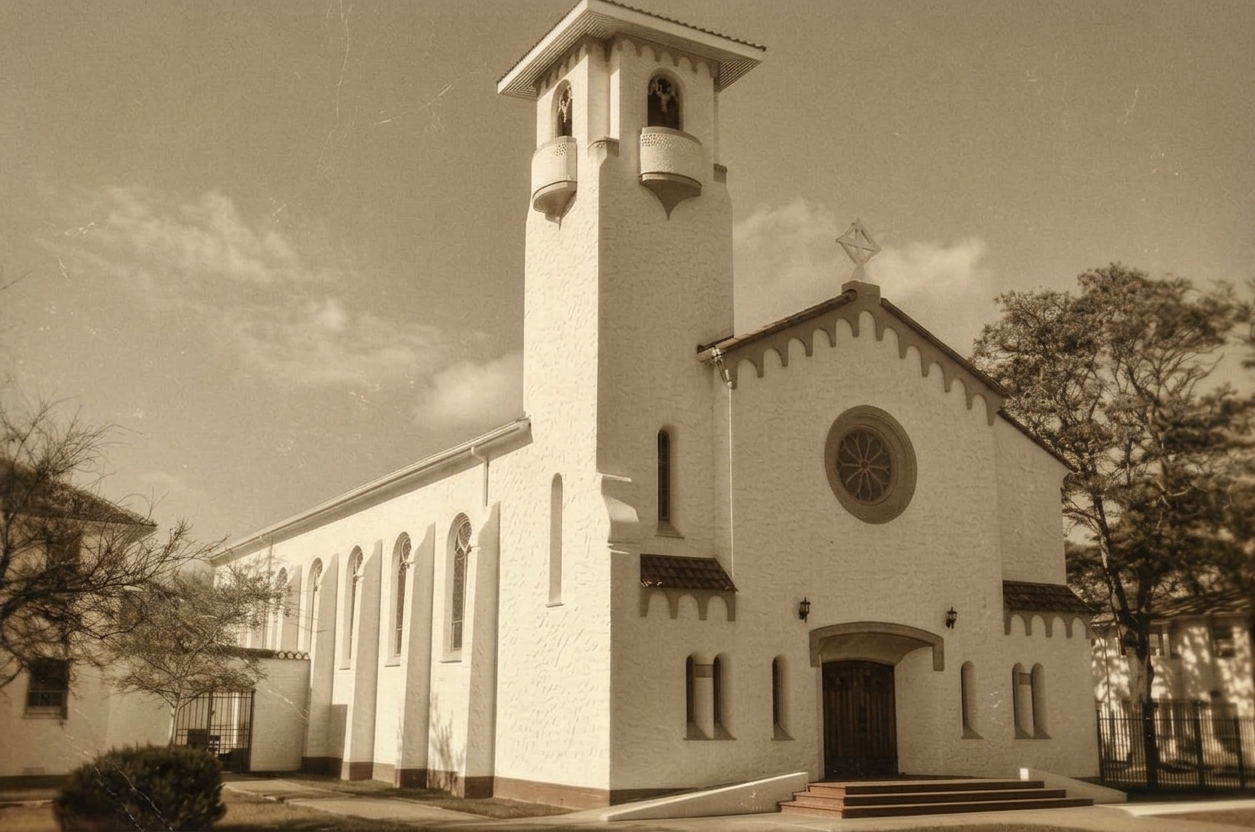
As you entered the foyer and then the church today, I am sure that you noticed all the lit candles on the walls. Those are the 12 places where, when the church was first dedicated, the bishop would have anointed the walls. Today we celebrate the anniversary of the dedication of St Bernadette’s Church. We give thanks not simply for a building of bricks and benches, mortar and mouldings, but for a sacred place where heaven touches earth, where God encounters His people, and where persons are brought into communion with one another through our shared bond of faith.
In our first reading, the prophet Ezekiel describes a remarkable vision he has received from God. He say the heavenly Jerusalem, and the heavenly temple. Water flows from the Temple, beginning as a small stream and gradually becoming a mighty river. Wherever this water flows, it brings life. Trees flourish, fish multiply, and even the waters of the Dead Sea are made fresh.
This is a beautiful image of the Church. From Christ, the true Temple, flows the living water of divine grace. Through the sacraments, especially Baptism and the Eucharist, that grace reaches us, transforming our lives and bringing spiritual life where there was once barrenness.
St Bernadette’s Church is one of the places where this heavenly grace flows. Here, children have been baptised, sinners are reconciled, marriages are blessed, and the faithful reverently receive the Body and Blood of Christ. Here, generation upon generation have encountered the triune God., Father Son and Holy Spirit.
But a church is also a place of connection. It connects us vertically, with God, and horizontally, with one another. We come here not as isolated individuals, but as members of a family united by faith.
We live in an age when people are more connected technologically than ever before, yet loneliness and isolation remain widespread. We can communicate instantly with someone on the other side of the world, while possibly not knowing the person’s name who lives next door. The parish church offers something different: a community founded not merely upon shared interests, but upon our common relationship with Jesus Christ.
In today’s Gospel, Jesus cleanses the Temple because those in charge of it had lost sight of its sacred purpose. When challenged, He declares: “Destroy this temple, and in three days I will raise it up.” St John explains that Jesus was speaking of the temple of His Body.
Christ Himself is the true meeting place between God and humanity. Through Baptism, we become members of His Mystical Body, the Church.
This means that St Bernadette’s is not an isolated religious community. It belongs to something infinitely greater: the one, holy, catholic and apostolic Church, extending across nations and centuries, uniting the faithful on earth with the saints in heaven.
Our connection with Christ must therefore also be a connection with His universal Church. We cannot separate Christ from the Church He established, nor can we reduce Christianity to a collection of individual religious opinions.
St John Henry Newman came to understand this truth through a long and sometimes painful spiritual journey. Newman began his ministry as an Anglican clergyman and became one of the most influential religious thinkers at Oxford. His study of the early Church Fathers gradually convinced him that the fullness of the Christian faith was preserved in the Catholic Church. He recognised that Christ had not left His followers to determine religious truth independently, but had established a visible Church with the authority to teach in His name.
His conversion came at considerable personal cost. He sacrificed his position, reputation and many cherished friendships. In September 1843, two years before his conversion, Newman preached his final Anglican sermon, entitled The Parting of Friends, at the church he had built in Littlemore.
Significantly, it was the anniversary of that church’s dedication.
In that deeply moving sermon, Newman reflected upon the spiritual bonds that unite Christians. He spoke of those who had helped others discover that there was “a higher life than this daily one, and a brighter world than that you see.”
These words remind us of what a church should be: a place where we help one another discover that higher life and prepare for that brighter world.
On 9 October 1845, Newman was received into the Catholic Church by Blessed Dominic Barberi. His conversion was not a rejection of his earlier search for God, but its fulfilment. He had come to recognise in the Catholic Church the living continuity of the faith of the Apostles.
Newman’s journey reminds us that the Church is more than a community offering friendship and belonging. It is also the divinely appointed guardian of truth.
As St Paul teaches, the Church is “the pillar and bulwark of the truth” (1 Timothy 3:15). Christ promised that the Holy Spirit would guide His Church into all truth. Through the teaching authority of the Pope and the bishops in communion with him, the Magisterium faithfully preserves, interprets and proclaims the revelation entrusted to the Apostles.
This is especially important in a world where truth is increasingly regarded as something each individual determines for himself. The Church does not invent the truth; she receives it from Christ and faithfully hands it on.
Our patroness, St Bernadette, understood this spirit of humility before divine truth. Although she had little formal education, she possessed a profound faith. When Our Lady appeared to her at Lourdes, Bernadette did not seek attention or personal glory. She simply and faithfully communicated what she had been entrusted to say.
Like Newman, she reminds us that holiness requires humility, obedience and fidelity to the truth.
As we celebrate this anniversary, let us give thanks for all those who have made St Bernadette’s a spiritual home: the priests who have served here, the families who have worshipped here, and the generations who have passed on the Catholic faith.
But let us also remember that our task is not merely to preserve a building or maintain a parish community. It is to remain firmly united to Christ and His Church, and to bring others into that communion.
May St Bernadette’s always be a place where people encounter God, discover friendship, receive the truth of the Catholic faith, and grow in holiness. Amen.