
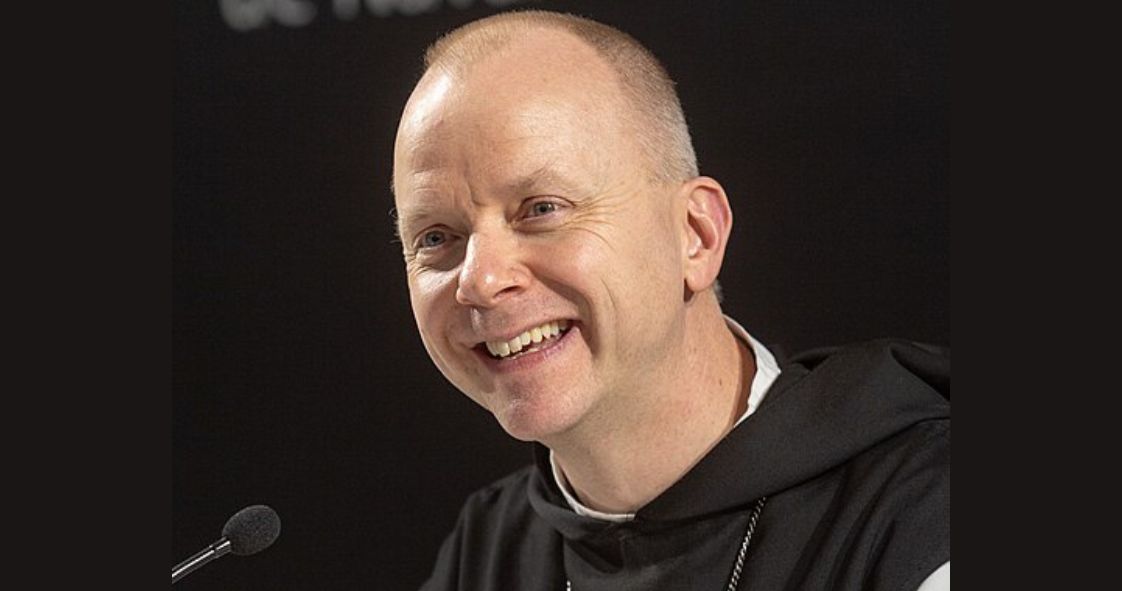
Bishop Erik Varden began his addresses on the first Sunday of Lent with these words: “Lent confronts us with essentials. It takes us, materially and symbolically, into a space stripped of superfluities. Things apt to distract us, even things wholesome in themselves, are removed for a season. We embrace an abstinence of the senses.” This focus on the essentials leads us, Bishop Varden suggested, to enter more deeply into that peace “which the world cannot give”. The bishop described a traditional Gregorian chant setting for this Sunday, the “tract” used at Solemn Masses based on Psalm 90, a “peaceful melody” which is however “not just a relic of ancient aesthetics” but which rather “carries a vital message.” This psalm text was the object of a series of sermons of St Bernard of Clairvaux (1090–1153), a foundational figure in the Cistercian Order of which Bishop Varden is a member. These sermons, in which Bernard reflects “on what it means to live by grace” as we “fight evil”, “foster good” and “uphold truth” summon us today to “loving and clear-headed discipleship”.
The second conference was on “Bernard the Idealist” and showed the high Christian ideals embodied by this great founder, preacher and theologian. Bernard and his associates were both conservative and radical, Bishop Varden suggested to the Pope and Cardinals, whilst being a “genuinely humble man, fully given to God, capable of tender kindness, a firm friend — indeed, able to befriend former enemies — and a compelling witness to God’s love.” According to Erik Varden, Bernard, a person of deep conviction and demanding in his expectations of others, learnt through many personal struggles and sufferings “not to take it for granted that his course is always the right course” and so becomes a “good, wise companion for anyone setting out on a Lenten exodus from selfishness and pride, wishing to pursue authenticity with eyes set on the all-illumining love of God.”
The third conference, on “God’s Help”, returned to Psalm 90, which begins with the words “He who dwells within the help of the Most High”. How do we understand God whom we call upon for help? Bishop Varden strikingly observed that “God’s help is not occasional to us; it is not an emergency service we call out now and then, when a house is burning or someone has been hit by a car, the way we might dial 999.” Rather, the bishop said that according to St Bernard “God’s help may indeed be called a habitat [dwelling place] in as much as it forms a sustaining reality within which we can live, move, and have our being.” Yet when we do seek God’s help in suffering, as in the case of Job, we often seem to receive no answer. The bishop asks “what about occasions when God-fearing people cry out to heaven but get no perceptible response, hearing only the desolate echo of their own voice?” When in great suffering our “world” itself seems to collapse, this invites us to deeper faith. God is at work in our trials and desolations, leading to Erik Varden’s perceptive remark: “God can enable a new world to emerge after he has pulled down walls we thought were the world, walls within which we actually suffocated.”
In the fourth conference, “Becoming free”, the bishop reflected on the nature of freedom. Freedom is often invoked in contemporary discussion in politics and in the media. Erik Varden strikingly observed: “A variety of political causes in Europe now harness the jargon of freedom. Tensions result. What one segment of society perceives as ‘liberating’ is found oppressive by others. Opposing fronts are raised, with the banner of ‘freedom’ held high on all sides. Bitter conflicts arise from incompatible agendas of purported liberation.” Christian freedom, understood as being lived in Christ, is to participate in Our Lord’s “yes” to the Father. “Christian freedom is not about seizing the world with force; it is about loving the world with a crucified love magnanimous enough to make us freely wish, one with Christ, to give our lives for it, that it may be set free.”
In the fifth conference, on the “Splendour of the Truth”, Bishop Varden quoted St Bernard: “‘I would have you warned: no one lives on earth without temptation; if one is relieved of one, let him surely expect another”. Yet temptation can be useful if we resist in and through Christ; through this our “commitment to the truth will be strengthened”. But “What is truth?” The bishop told his audience in Rome: “People of our time ask this question earnestly, often with remarkable good will, notwithstanding their confusion, fear, and the rush they are always in. We cannot let it go unanswered.” He went on: “We need our best resources to uphold substantial, essential, freeing truth against more or less plausibly shining, more or less fiendish substitutes.” Among such substitutes, the bishop noted: “It is tempting to think we must keep up with the world’s fashions. It is, I’d say, a dubious procedure. The Church, a slow-moving body, will always run the risk of looking and sounding last-season. But if she speaks her own language well, that of the Scriptures and liturgy, of her past and present fathers, mothers, poets, and saints, she will be original and fresh, ready to express ancient truths in new ways, standing a chance, as she has done before, of orienting culture.”
In the sixth conference, “The Fall of Thousands”, the bishop spoke of sin and focussed on the “worst crisis of the Church” in the sexual abuse crisis. “Nothing has done the Church more tragic harm, and compromised our witness more, than corruption arisen within our own house. The worst crisis of the Church has been brought on, not by secular opposition, but by ecclesiastical corruption. The wounds inflicted will take time to heal.” Seeking to penetrate where matters may have gone wrong, the bishop noted: “Bernard reminds us that where people pursue noble endeavours, enemy attacks will be fierce”. The devil was very real for St Bernard. However, “this is not to say that he ascribes all spiritual disease to villains with horns and pitchforks”, but “holds men and women responsible for the way in which they use their sovereign freedom”. The bishop suggested that if we “begin to go deep into our spiritual nature, other depths are perforce laid bare” and that we “shall face existential hunger, vulnerability, a yearning for comfort.” In such an experience there is opportunity for either growth or disorder. Spiritual teachers, specifically, Bishop Varden suggested, will be tested by how they respond to such experiences: “the integrity of a spiritual teacher will be attested by his conversation, but not only; it will be evidenced as much by his online habits, his comportment at table or at the bar, his freedom with regard to others’ adulation.”
The seventh conference was on “Glory”. The bishop spoke of the time when “many of his [Jesus’] disciples drew back and no longer went about with him”. Bishop Varden suggested: “They would not put up with his discourses about sacramental realism, the indissolubility of marriage, the necessity of the Cross. When Christ was crucified on Calvary, the synodos [assembly] that had walked with him six days before was no more. Two followers only remained: his Mother and John, the Beloved Disciple.” Bishop Varden highlighted the paradox that it was here, at the Cross, betrayed and rejected, that the glory of Christ was manifested. St Bernard stated that “Glorification happens in the presence of God’s face” – that is, the bishop explained, “when, our earthly voyage done, we shall at last behold what in this life we have firmly hoped for, putting our trust in Jesus’s name.” But, referring to the title of his conferences, Bishop Varden affirmed that “a ‘hidden glory’ is perceptible even now” and that the “Church reminds women and men of the glory secretly alive in them. She shows us that present mediocrity and despair, not least my despair at my own persistent failures, need not be final; that God’s plan for us is infinitely lovely; and that God, through Christ’s Mystical Body, will give us grace and strength, if only we ask.” He continued: “The Church manifests the radiance of ‘hidden glory’ in her saints. They stand as proofs that even illness and degradation may be means providence uses to realise a glorious purpose, bestowing strength on the feeble and making them radiant.” Moreover, he went on: “The Church channels ‘hidden glory’ in her sacraments. Any Catholic knows what light can break forth in the confessional, in an anointing, at an ordination or a wedding. Most splendid, and in some ways most veiled, is the glory of the Holy Eucharist.”
The eighth conference was on “God’s Angels”. Bishop Varden explained that the popular prayer “Angel of God” is traceable to St Bernard’s contemporary Reginald of Canterbury, in which we “ask our guardian angel to ‘enlighten, keep, govern, and guide’ us.” The bishop noted: “These are hefty verbs.” Weighty words, indeed, because of what it is precisely that an angel guards: “An angel is a guardian of holiness.” Bishop Varden told the Roman Curia: “The angels’ last, most decisive act of charity will happen when, at the hour of our death, they will bear us through this world’s veil into eternity.” Bishop Varden also mentioned St John Henry Newman, who called the ministry of the priest angelic. Bishop Varden meditated: “The priest is at home in this world, unafraid to go into dark woods in search of the lost. At the same time he keeps his mind’s eyes raised towards the Father’s face, letting its radiance illumine all present reality.” He concluded by extending this idea from priests to all Christian teachers: “Newman, now a Doctor of the Church, invites us to rediscover the teacher, too, as angelic enlightener.” Bishop Varden reflected: “It is a prophetic challenge, given how much so-called ‘education’ is now farmed out to digital, artificial media, while young people yearn to meet teachers who are worthy of trust, who can impart not only skills but wisdom. An angelic encounter is always personal. It cannot be replaced by a download or a chatbot.”
The ninth conference was on “Bernard the Realist”. Bishop Varden told his audience that St Bernard could be “intransigent” and “fierce” based on his high ideals, an aspect of his character that never left him. But the bishop said that it was “sweetened” over time: “It turned the idealist into a realist.” And he made the insightful observation: St Bernard “became a realist not merely in the sense of accepting things as they are.” Rather, the bishop stated, “he learnt above all that the deepest reality of all human affairs is a cry for mercy.” In the disorders and clamours of our world it is possible to recognise humanity’s desire of and cry for mercy. And the more St Bernard identified this cry “in human hearts, in bitter tears, in worldly conflicts, in madcap campaigns against decency and truth, and in the whisper of the trees of the forest, the more he was conscious of God’s gracious response.” God’s response to humanity’s cry for mercy St Bernard found especially in the name of Jesus. St Bernard said: “Write what you will, I shall not relish it unless it tells of Jesus. Talk or argue about what you will, I shall not relish it if you exclude the name of Jesus. Jesus to me is honey in the mouth, music in the ear, a song in the heart.” St Bernard thus understood situations, persons, and relationships “resolutely in Jesus’s light”. This orientation, the bishop noted, has won him admirers from outside the Catholic fold, from Martin Luther to John Wesley.
The last conference but one is on “Consideration”, the title of a work of St Bernard which he wrote for the Pope of the time, Eugene III, who had previously been a student and fellow-monk of St Bernard. Consideration, as understood in St Bernard’s usage of the word, is to seek truth in everyday affairs, “thought searching for truth, or the searching of a mind to discover truth.” St Bernard recommended Pope Eugene to surround himself with good people as “better the Church’s central offices are run, the greater the benefit will be for the Church worldwide.” Such collaborators would be, as Bernard puts it, “of proven sanctity, ready obedience, and quiet patience”, as well as “catholic in faith”, “faithful in service”, but also “inclined towards peace” and “desirous of unity”. These people, St Bernard concludes: “habitually devote themselves to prayer” and “in every undertaking place more confidence in it than in their own industry or labour.” This is the true model for church officials, Bishop Varden stated. “In so far as the Church operates in these terms will she reflect the organisation of the angels’ hierarchies.”
The final conference is entitled “To Communicate Hope” and offers illuminating perspectives on the church in the contemporary world. Bishop Varden quoted Saint John XXIII as he opened the Second Vatican Council, in which the Pope stated that the Council’s greatest concern would be that “the sacred deposit of Christian doctrine should be guarded and taught more efficaciously … it bids us, pilgrims on this earth, tend towards our heavenly home.” In the fraught atmosphere of those times (the Cuban Missile Crisis broke out a week later) but amidst the strong desire of so many for a new form of society based on “human rights”, “fair trade” and “technical advances” the Pope and Council desired to grasp contemporary earthly events in their truest light. Christ alone is the Light of the Nations (Lumen Gentium, the name of the Council’s Constitution on the Church). But the hope and truth that are in Christ are not realised in a single moment in our world: “He can act through us if we consent to being patient. Lent shows us that God, suffering the wound of his philanthropy, is at his most active in his Passion. The hope he entrusts to us is not hope in a finally modernised, digitised, sanitised Vale of Tears. Our hope is in a new heaven, a new earth, in the resurrection of the dead.” And our time, the bishop suggested, referring in a special way to the young, is “hungry to hear this hope proclaimed”. He concluded: “Our time is crying out for the Gospel in fullness. The young lamenting in our parks with heavy hearts hunger for it. They do listen when it is presented ‘with authority’ by Christians able at once to expound and display the truth of it without compromise, showing Christ’s gracious power to renew and to transform lives.”
Click here to read the remarks of Pope Leo XIV at the conclusion of the retreat