
How different is your life from what you imagined it would be when you finished school?
Is this the city in which you expected to live? Did you know your spouse at the time? Did you imagine the career you would follow, the responsibilities you would carry, or the challenges you would face?
Perhaps you are still at school, or have recently finished. No doubt, you have plans and hopes for the future.
Today’s readings give us a window into the lives of people whose lives unfolded in ways they could never have imagined.
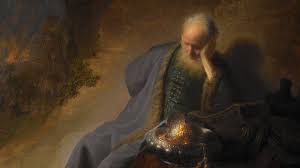
The First Reading introduces us to Jeremiah. He lived in the late seventh and early sixth centuries before Christ, during the final years of the Kingdom of Judah before the destruction of Jerusalem by the Babylonians.
Jeremiah is often remembered as the reluctant prophet or the weeping prophet. Reluctant not because he was unwilling to do God’s will, but because he knew the cost of being a prophet. When God called him, he protested: “Ah, Lord God! Truly I do not know how to speak, for I am only a youth.”
God sent Jeremiah to call the people back to covenant faithfulness. He denounced idolatry, injustice, and false worship. His message was not popular. People wanted reassurance; Jeremiah preached repentance.
Shortly before today’s reading, Jeremiah had been beaten and publicly humiliated by Pashhur, a priest responsible for the Temple. Pashhur had Jeremiah placed in the stocks before the people. In response, Jeremiah gave him a new name: Magor-missabib – “Terror-on-every-side” – a sign that judgment was coming upon him and the nation.
It is immediately after this humiliation that Jeremiah cries out:
“I hear so many disparaging me, ‘Terror from every side!’ … All those who used to be my friends watch for my downfall.”
Jeremiah’s life had become far more difficult because he had been faithful to God’s call.
The Responsorial Psalm is taken from Psalm 69, traditionally attributed to King David.
David’s life also unfolded in ways he could never have foreseen as a young shepherd boy tending his father’s sheep in Bethlehem. The youngest son of Jesse, from the tribe of Judah, he was unexpectedly anointed by the prophet Samuel to become king.
David became Israel’s greatest king, yet his life was marked by trials, responsibilities, betrayals, and sorrows. Leadership brought honour, but it also brought suffering.
In today’s Psalm we hear David lamenting the cost of his fidelity to God:
“It is for you that I suffer taunts, that shame covers my face, that I have become a stranger to my brothers.”
Like Jeremiah, David discovered that serving God did not exempt him from hardship.
The Apostles, perhaps even more than Jeremiah or David, lived lives far different from what they might have imagined in their youth. Most were simple fishermen. One was a tax collector. Several were married men. When they followed Jesus, they likely expected that the long-awaited Kingdom of David was about to be restored.
Little did they realise how different Christ’s Kingdom would be.
Jesus knew exactly what lay ahead. He knew the opposition they would face. He knew that nearly all of them would eventually give their lives for the Gospel. That is why, in today’s Gospel, he repeatedly tells them:
“Do not be afraid.”
And again:
“Do not fear those who kill the body but cannot kill the soul.”
When we reflect on our own lives, it is easy to become overwhelmed by difficulties, disappointments, and regrets. Though there are many blessings too, we often find ourselves focusing on what is lacking rather than what has been given.
Many people spend their lives searching for peace. Some look to self-help gurus. Others seek escape through distraction, comfort, or endless entertainment. Some attempt simply to surrender to circumstances and become indifferent to what happens.
The Scriptures propose a different path.
Our peace and joy are found in remaining faithful to God, even when doing so is difficult.
The point is not to seek difficulties, nor to imagine that every hardship is God’s will. Rather, the challenge is to remain faithful when difficulties arise precisely because we are trying to do what is right in the sight of God.
In fact, when faithfulness meets opposition, something important happens. We discover that we cannot persevere by our own strength alone.
We learn to rely on God.
Jeremiah turns to the Lord and prays:
“To you I have committed my cause.”
David likewise cries out:
“This is my prayer to you, my prayer for your favour. In your great love, answer me, O God.”
These are not prayers of despair, but prayers of trust. Both men know opposition. Both know disappointment. Yet both entrust themselves to the Lord.
This is the assurance Jesus offers the Apostles in today’s Gospel:
“Can you not buy two sparrows for a penny? And yet not one falls to the ground without your Father knowing. Why, every hair on your head has been counted. So there is no need to be afraid; you are worth more than hundreds of sparrows.”
The Lord does not promise to remove every obstacle from our path. He does not silence all of Jeremiah’s enemies, erase all of David’s sorrows, or spare the Apostles every hardship.
Instead, he promises something greater: his presence.
The challenge beneath all the challenges we face is whether we will continue to trust him.
And what of those plans we made in our youth? What became of them?
Some came true. Many did not. Most of us discovered that life unfolded very differently from what we expected.
Yet today’s readings remind us that God has plans for us too.
Jeremiah could never have imagined becoming a prophet. David could never have imagined becoming king. The Apostles could never have imagined that they would leave everything behind to proclaim the Gospel to the ends of the earth.
Yet God was at work in each of their lives.
The same is true for us.
By virtue of our Baptism, we share in Christ’s threefold mission as priest, prophet, and king.
Like Jeremiah, we are called to be prophets: witnessing to the truth by our words and by our lives.
Like David, we are called to share in Christ’s kingship: governing first our own hearts and then exercising loving responsibility within our families, workplaces, and communities.
Like the Apostles, we are called to share in Christ’s priesthood: offering our lives, our work, our sufferings, and our prayers to the Father in union with Christ.
None of these vocations are easy. All involve sacrifice. All require trust.
But they reveal something beautiful: our lives are not accidents. God has a purpose for each of us.
And it is often in the very difficulties we would most like removed that we discover what Jeremiah, David, and the Apostles discovered before us: that God is faithful, that he has not abandoned us, and that his grace is sufficient for whatever lies ahead. Amen.