
11 & 12 April 2026, 2nd SUNDAY OF EASTER
This Second Sunday of Easter has many names. The Octave Day of Easter – being eight days after Easter Day itself; Low Sunday – the name traditionally used most in England, as today is a great feast but “low” in comparison with the “high” day of Easter Sunday; Domenica in Albis, or white Sunday, from the white clothing traditionally worn by those who had been baptised at the Easter vigil and today removed it, recalling to us the focus on our newly baptised brothers and sisters, the five new Christians baptised at the Easter Vigil last week – we continue to pray for them; finally in modern times today is also Divine Mercy Sunday recalling the private revelations of Our Lord to Sister Faustina Kowalska in the twentieth century, a devotion much encouraged by St John Paul II. However, whichever name we use this Sunday cannot but centre on a single mystery – that of the Resurrection of Jesus Christ – of which today could be called the principal celebration after Easter Day itself. This is a mystery most certainly not exhausted on one single day. Let us look at the readings.
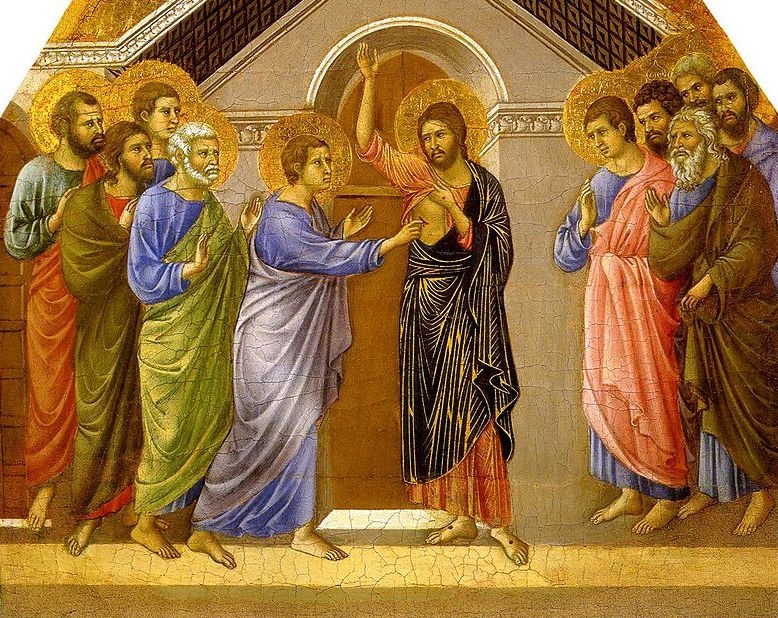
First let us take the Gospel. This includes the famous episode with so-called “doubting” Thomas. You do not need me to recount the story. Whilst Thomas is called “doubting” (“faithless” is the term used by Our Lord) we must not omit to state that Thomas makes the greatest Easter affirmation of faith that has come down to us, affirming not only the resurrection but also the divine nature of Christ: “My Lord and my God!” Note, further, that it is Thomas’ encounter with the risen Christ that moves him to this act of faith. This in fact can be taken as a model for Christian belief – that it is mediated through the encounter with the risen Christ. For some this encounter was in person – the Evangelists and St Paul describe those who had this privilege – but for others (to whom Our Lord refers and which includes ourselves) we encounter Jesus through the preaching of the Church in which the resurrection is at the very centre. The Acts of the Apostles, time and again in the preaching of St Peter and St Paul, shows how many people there were who – specifically on hearing about the truth of the resurrection – became blessed because they had not seen but yet truly believed.
The second reading looks at a different aspect. St Peter here speaks not to potential believers but to those who had already professed Faith in the paschal mystery of Our Lord. Peter speaks of the Faith of his hearers and its “genuineness” – it is said also to be “precious” – but he goes on to state that this Faith can be tested by trials and sufferings. “For a little while you may have to suffer various trials”. If the Gospel describes the act of coming to Faith, the second reading describes a second stage, that of Faith’s purification or growth, which can take place through the patient acceptance of suffering. But in this passage St Peter also speaks further of another virtue, that of hope. The object of Faith is God and his risen Son. The object of hope is our own destiny with God in heaven and our share in Christ’s resurrection. If the resurrection gives birth to Faith, it also gives birth to hope that we will one day share in that resurrection, and this is precisely what St Peter says: “Blessed be the God and Father of our Lord Jesus Christ … [for] by his great mercy we have been born anew to a living hope through the resurrection of Jesus Christ from the dead, and to an inheritance which is imperishable, undefiled and unfading”.
Note one more thing St Peter says: “Without having seen him, you love him”. This recalls Our Lord’s words in the Gospel “Blessed are those who have not seen and yet believe” but St Peter’s words are different because they speak not of Faith but of Divine love or Charity. Peter’s first readers had professed Faith in Christ and his paschal mystery, they had been reborn to a living hope in their own share or participation in that mystery, but also kindled in their souls thereby was the fire of divine love, as Paul says: “God’s love has been poured into our hearts through the Holy Spirit who has been given to us.” (Romans 5:5) And it is the same St John the Apostle, present with Our Lord and St Thomas in the upper room (“put your finger here, see my hands” – “place your hand in my side”, etc.) who speaks in his first epistle of that “which we have heard, which we have seen with our own eyes, which we have looked upon and touched with our hands” (1 John 1:1) and goes on to say “see what love the Father has [therefore] given us, that we should be called children of God.” (1 John 3:1) Our Lord’s paschal mysteries infuse divine charity into the Christian soul. Finally, this love is not only for God, but for others for God’s sake. St John specifically says in that same epistle: “We know that we have passed out of death and into life, because we love the brethren” (1 John 3:14). That love is shown beautifully in today’s first reading, concretely, in the giving up of material things and in that bond of charity with which the early Christians celebrated the “breaking of the bread”, that is the sacrament and sacrifice of the Holy Eucharist. Amen.