
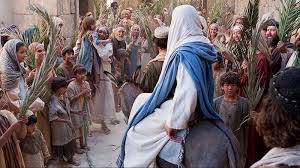
28 & 29 March 2026, PALM SUNDAY
We stand at the threshold of Holy Week, and the Church places before us something deeply striking, unsettling. Within a single liturgy, we are made to experience two completely different realities. At the beginning, there is joy, acclaim, and celebration: “Hosanna to the Son of David!” Jesus enters Jerusalem as a king, welcomed by the crowds, honoured and praised. And yet, only moments later, we are plunged into the Passion where we hear that familiar narrative of betrayal, suffering, humiliation, and death. The same voices that cried out in praise turn to cry out, “Crucify him!”
Palm Sunday forces us to confront a difficult truth: things are not always as they seem. What appears to be victory may, in fact, be deceiving or fleeting. And what appears to be defeat may be the very place where God is accomplishing His greatest work.
The key to understanding this lies in the psalm that we hear today: Psalm 22. It is one of the most powerful and haunting texts in all of Scripture, and it is deeply woven into the Passion narrative. When Jesus hangs on the Cross and cries out, “My God, my God, why have you forsaken me?” He is certainly crying out in anguish, but this is not all he is doing. He is invoking this psalm. And those who stood there would have recognised it immediately. In Jewish tradition, to quote the opening line of a psalm is to call to mind the whole.
And what does this psalm reveal?
It begins in a place of profound desolation: “My God, my God, why have you forsaken me? Why are you so far from helping me, from the words of my groaning?” It gives voice to that terrible experience of abandonment, of feeling utterly alone, of crying out to God and hearing no answer. “O my God, I cry by day, but you do not answer; and by night, but find no rest.”
And yet, even here, something remarkable is happening. The psalmist does not turn away from God, he turns towards Him. Even in the cry of abandonment, he still says, “My God.” There is pain, but there is also relationship. There is anguish, but there is also trust.
The psalm continues, and we begin to hear echoes that resonate uncannily with the Passion. “All who see me mock at me; they make mouths at me, they shake their heads: ‘He trusted in the Lord; let Him deliver him; let Him rescue him, for He delights in him!’” These are almost the very words spoken beneath the Cross. The suffering is physical, but it is also social, emotional, spiritual. It is rejection, humiliation, exposure.
Then the imagery becomes even more vivid: “I am poured out like water, and all my bones are out of joint… my heart is like wax; it is melted within my breast.” “My strength is dried up like a potsherd, and my tongue sticks to my jaws.” “They have pierced my hands and my feet… they divide my garments among them, and for my clothing they cast lots.”
It is hard to hear these words and not see the Cross.
And yet, this is not where the psalm ends. There is a turning point. After all the suffering, after all the anguish, the tone begins to change. A quiet but profound confidence emerges: “But you, O Lord, do not be far away! O my help, come quickly to my aid!” And then, suddenly, the psalm breaks into praise: “I will tell of your name to my brothers and sisters; in the midst of the congregation I will praise you.” “You who fear the Lord, praise Him! … For He did not despise or abhor the affliction of the afflicted; He did not hide His face from me, but heard when I cried to Him.”
This is the movement of the psalm: from abandonment to trust, from suffering to praise, from darkness to a quiet but unshakeable confidence that God has not abandoned His faithful one.
And this is exactly what is happening on the Cross.
From the outside, everything looks like failure. Jesus is rejected, condemned, stripped, mocked, and executed. It appears that evil has won, that truth has been silenced, that love has been defeated. But from within, from the perspective of faith, something entirely different is taking place. This is not defeat. This is the moment of total self-gift. This is the moment in which Christ entrusts Himself completely into the hands of the Father.
And that is why Saint Paul can say, in the second reading, that Christ “humbled himself, becoming obedient unto death, even death on a cross.” And because of that obedience, because of that total trust, “God highly exalted him and gave him the name which is above every name.”
Here we see the pattern of the Christian life. The way of Christ is not a way of worldly triumph, of immediate success, of visible glory. It is the way of humility, of surrender, of trust, especially when things do not make sense, when God seems distant, when life feels heavy or uncertain.
Palm Sunday invites us to ask ourselves a very personal question: how do we respond to Christ?
It is easy to walk with Him when the crowds are cheering. It is easy to follow when faith feels consoling, when prayer is fruitful, when life is going well. But what about when the path leads to the Cross? What about when following Christ requires sacrifice, or forgiveness, or letting go of something we cling to?
The crowds who shouted “Hosanna” were not necessarily insincere, but their understanding was limited. They were looking for a Messiah who would bring immediate victory, who would fulfil their expectations. And when Jesus did not conform to those expectations, their enthusiasm turned.
And we are not so different.
We too can be tempted to follow Christ on our own terms. To welcome Him when He fits into our plans, but to resist Him when He challenges us, when He calls us deeper, when He invites us into the mystery of the Cross.
This Holy Week we begin today is not meant to pass like any other week. It is the most sacred time of the year. It is an opportunity to walk with Christ, to accompany Him, step by step, through His Passion, His death, and ultimately, His Resurrection.
I want to encourage you, very simply and concretely, to enter into this week with intention. Make time each day for prayer, even if it is just a few quiet moments. Read the Gospel passages of the day, and allow them to speak to you. Participate in the liturgies of the Triduum: Holy Thursday, Good Friday, and the Easter Vigil. If you cannot be present physically, unite yourself spiritually. Perhaps renew those Lenten disciplines that have slipped over the past 6 weeks. Enter into the fast of Good Friday with purpose, not as an end in itself, but as a way of turning your heart more fully towards God.
Above all, be attentive. Because this week is not just about recalling what happened long ago. It is about allowing the mystery of Christ’s love, revealed most fully on the Cross, to touch your life here and now.
Today we hold palms in our hands which are symbols of victory, of celebration. But they will fade. They will wither. The Cross, however, remains. It stands at the centre of our faith as the revelation of a love that endures to the end, but which, at the beginning looked like defeat.
As we begin this Holy Week, let us ask for the grace not to be deceived by appearances, but to recognise Christ in both glory and suffering. And let us have the courage to follow Him, not only in the moments of joy, but all the way to the Cross. Trusting that there, and only there, we will discover what true victory really is. Amen.